

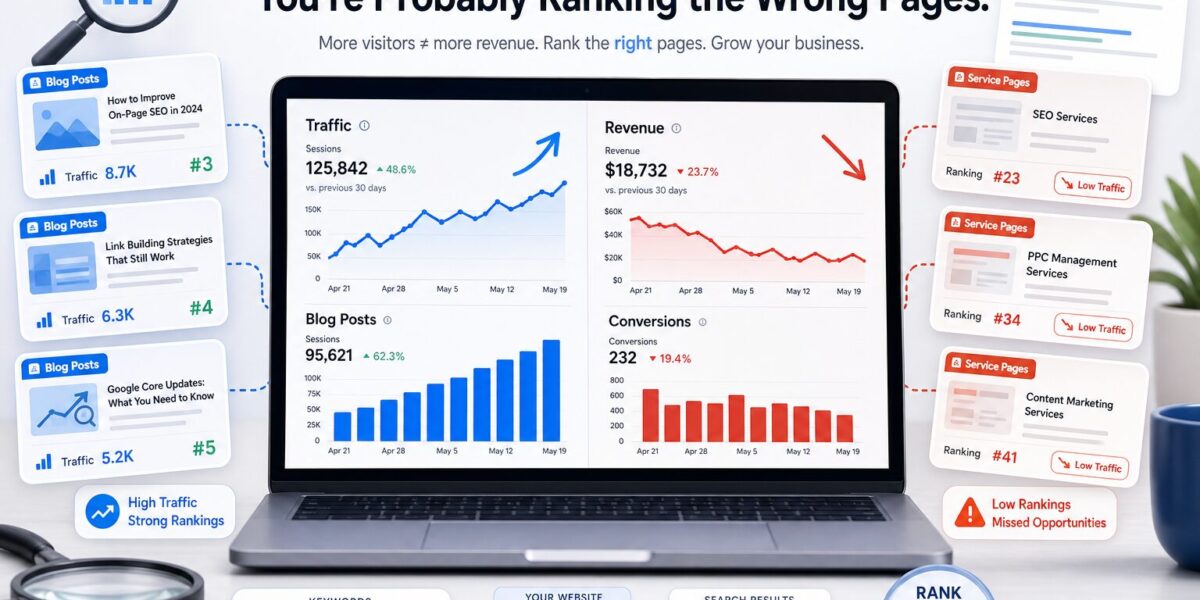
After 20+ years in SEO, there’s a mistake I still see all the time in reporting: traffic goes up, the agency celebrates, and the business owner still feels broke.
And honestly? The business owner is usually right.
I’ve seen this in real audits for service businesses, local companies, and B2B sites that looked healthy in Google Search Console but weak in the places that actually mattered: leads, calls, demos, and revenue.
I’ve worked with businesses that ranked for dozens of educational terms and still struggled to generate qualified leads. I’ve built recovery plans around that exact problem. I noticed the pattern years ago: the reporting looked great right up until someone asked where the revenue was.
More organic traffic does not automatically mean better SEO. If that traffic is landing on the wrong pages, attracting the wrong visitors, or stopping one step short of conversion, your reporting may look pretty while your pipeline stays flat.
That’s the trap.
A lot of SEO campaigns are built to win screenshots, not revenue. They chase impressions, blog traffic, and “top 10 keyword growth” while the pages that actually make money — service pages, landing pages, location pages, product pages, comparison pages, quote-request pages — either stagnate or lose ground.
If your SEO isn’t driving leads, calls, demos, or sales, there’s a good chance you’re ranking the wrong pages.
Traffic is not the goal. Qualified demand is.
Let me say this as clearly as possible: producing content is not the same thing as doing SEO well.
SEO is not just “publish more blogs and wait.” SEO is turning search visibility into business outcomes.
That distinction matters even more now because search has changed. According to SparkToro’s 2024 zero-click study, nearly 60% of Google searches end without a click, and in the U.S. only about 360 clicks per 1,000 searches go to the open web.
So if you’re already fighting for fewer clicks, wasting those clicks on low-intent traffic is even more expensive.
That’s why “traffic up” has become one of the most misleading success metrics in marketing.
The real problem: ranking informational pages while your money pages fall behind
Informational content has a place. I’m not anti-blog.
A strong article can build authority, capture early-stage demand, earn links, support topical relevance, and help buyers discover you. But informational content is only valuable when it supports a broader revenue strategy.
The problem starts when a site ranks for lots of educational, curiosity-driven, low-intent searches while the pages tied to actual buying decisions can’t gain traction.
That usually looks like this:
- blog posts are up,
- impressions are up,
- traffic is up,
- branded search may even be up,
- but form fills, calls, booked consultations, and closed revenue are flat.
Why? Because the site is getting discovered for questions, not decisions.
A person searching “what is local SEO” is not the same as a person searching “local SEO consultant for multi-location business.” One query is research. The other is much closer to revenue.
When I review underperforming campaigns, this is usually where competitors are quietly winning: their bottom-funnel pages are better aligned to buying intent, while their rivals are still feeding most of their authority into educational pages that rarely convert.
If your SEO strategy doesn’t reflect that difference, you can end up building an audience that never buys.
Search intent is where most SEO strategies quietly break
This is where a lot of campaigns go off the rails.
Google has been very clear that it wants content created for people, not content created just to manipulate rankings. In its guidance on helpful, reliable, people-first content, Google repeatedly emphasizes usefulness, firsthand value, and satisfying the user’s goal.
That lines up with my experience. The sites that perform best are usually the ones that make their commercial pages genuinely useful instead of treating them like thin sales brochures.
That last part matters because the user’s goal changes depending on the query.
Some searches are informational:
- how to improve website traffic
- what is technical SEO
- why rankings dropped after a core update
Some are commercial or transactional:
- SEO consultant Orlando
- local SEO services for law firms
- conversion rate optimization agency
- Google Ads management pricing
Those searches do not deserve the same page type.
If you’re publishing endless informational content while neglecting the pages built for commercial intent, you may be growing visibility without growing revenue.
That’s not a traffic problem. That’s a page-priority problem.
Why this issue is getting worse in 2026
This gap between traffic and revenue is becoming more obvious for three reasons.
1. Google is sending fewer easy clicks
Again, SparkToro’s data shows that a huge portion of searches never send traffic to websites at all. That means the traffic you do earn has to matter more.
2. AI Overviews are squeezing informational clicks
Ahrefs reports in its B2B SEO statistics roundup that AI Overviews reduce clicks to websites by 34.5%. Informational content tends to feel that squeeze first. If your strategy depends heavily on top-of-funnel blog traffic, you’re exposed.
3. Buyers are validating, not just discovering
According to Wynter’s 2025 B2B SaaS buyer research summary, 100% of surveyed CMOs visited the vendor’s website before purchase, but only 9% began with Google, while 24% used AI tools to compare vendors.
That means your website — especially your core service and solution pages — has to close the credibility gap fast.
If your site ranks for educational content but your actual money pages are weak, vague, generic, or under-optimized, you’re losing people at the exact moment they’re trying to validate you.
What the right SEO page mix actually looks like
A healthy SEO strategy doesn’t ignore informational content. It just gives it the right job.
1. Money pages come first
These are the pages closest to revenue:
- service pages
- location pages
- product pages
- sales pages
- comparison pages
- contact, estimate, and demo pages
These pages should be clearly positioned, written in plain English, tightly aligned to buyer intent, internally linked from supporting content, and built to convert.
2. Informational content supports those pages
Blog content should answer questions, build relevance, and create entry points. But it should also guide readers toward the next step, reinforce your expertise, and pass authority to the pages that matter most.
If your blog content is ranking but your service pages aren’t, your content engine may be working harder than your revenue engine.
3. Reporting should follow business outcomes
If your dashboard stops at traffic, impressions, and average ranking position, it’s incomplete.
You should be asking:
- Which organic landing pages generate leads?
- Which queries drive commercial-intent sessions?
- Are service pages gaining or losing visibility?
- Which pages contribute to calls, forms, booked meetings, and sales?
- What percentage of organic traffic lands on revenue-relevant pages?
That’s the conversation executives actually care about.
What businesses should measure instead
One of the better recent breakdowns on this came from Search Engine Land’s piece on retiring outdated SEO metrics. The article makes a point I agree with: standalone traffic metrics are often too shallow to explain whether SEO is helping the business.
A better measurement stack looks like this:
- organic conversions by landing page
- qualified leads from organic
- service-page visibility
- non-branded rankings for commercial queries
- assisted conversions
- call tracking from organic sessions
- revenue influenced by organic landing pages
- branded search lift after visibility campaigns
Traffic still matters. It’s just not enough by itself.
Even the conversion benchmarks support that idea. Ahrefs’ B2B SEO stats roundup cites Ruler Analytics showing an average 5.0% conversion rate for organic search. Organic traffic can be highly valuable — but only when it lands in the right places and matches the right intent.
The uncomfortable truth most agencies won’t say out loud
A lot of SEO teams default to blog production because it’s easier. I’ve had to explain this more than once after looking at sites that were publishing constantly but still losing high-intent traffic to better-positioned competitors.
It’s easier to publish “10 Tips” content than to fix weak positioning on service pages. It’s easier to report traffic growth than explain why commercial pages still aren’t converting. It’s easier to celebrate impressions than diagnose revenue leaks.
But easy SEO and effective SEO are not the same thing.
Sometimes the highest-leverage move is not another blog post.
Sometimes it’s:
- rewriting your service pages,
- improving internal linking,
- cleaning up cannibalization,
- aligning content to real buyer intent,
- clarifying your offer,
- or building pages that make it obvious why someone should choose you.
That work is less glamorous. It also tends to make more money.
I recommend starting with the pages closest to revenue first. Our approach should be simple: fix the pages buyers need when they are ready to act, then let supporting content strengthen those assets.
Final thought
If your SEO traffic is growing but your revenue isn’t, don’t assume the answer is “more content.”
The better question is: What pages are ranking, and what pages should be ranking?
That’s where the disconnect usually lives.
Because the goal isn’t to become more visible to everyone. The goal is to become more visible to the people most likely to buy.
And if your money pages are invisible while your blog posts do all the heavy lifting, you’re probably ranking the wrong pages.
Related reading: