

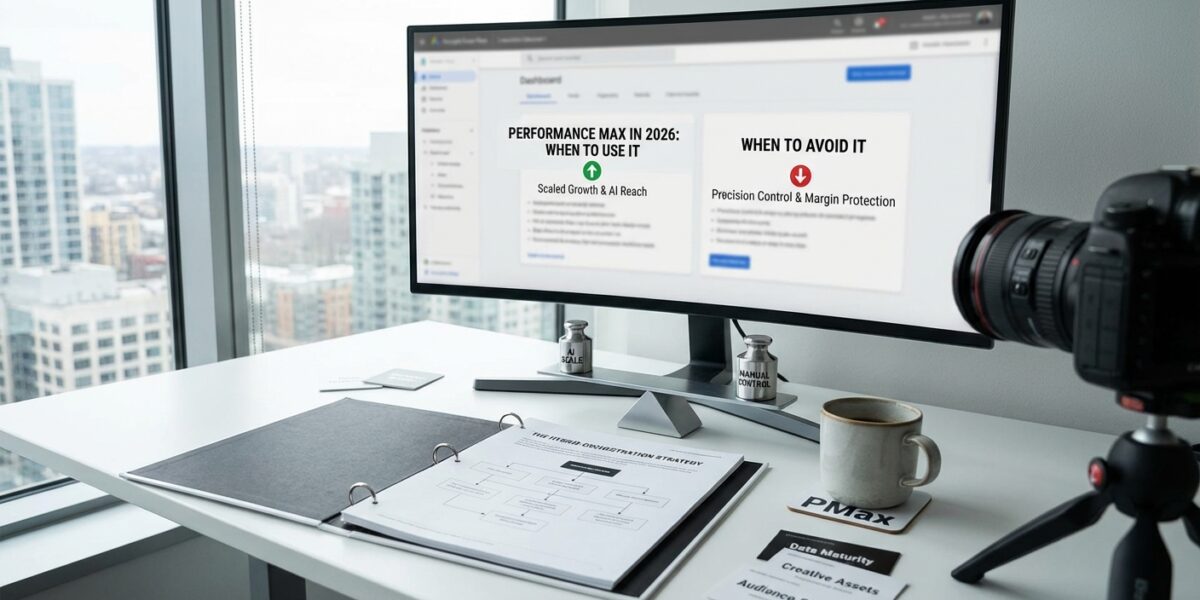
After managing Google Ads campaigns for over two decades, I’ve seen plenty of “revolutionary” features come and go. But Performance Max 2026 is different. It’s not just another campaign type—it’s fundamentally changing how we approach Google Ads automation and paid advertising strategy. The question isn’t whether you should use these PMax strategies, but when and how to implement them effectively.
I’ve been testing Performance Max since its early days, and let me tell you: it’s evolved dramatically. What started as a “black box” that frustrated advertisers has become a sophisticated performance max optimization tool that can deliver exceptional results—if you know when to use it.
What Makes Performance Max 2026 Different
Performance Max 2026 campaigns use Google’s advanced AI automation to serve ads across every Google property—Search, Shopping, Display, YouTube, Discover, Gmail, and Maps—from a single campaign setup. Think of it as having one campaign that can appear anywhere your customers are browsing or searching, powered by sophisticated Google Ads automation.
But here’s what changed in 2026: Google finally gave us the controls we’ve been begging for. We now have negative keywords, placement exclusions, and actual channel-level insights. wordstream.com reports that these performance max optimization improvements led to a 71% adoption rate among advertisers, up from 60% in 2024.
The numbers are compelling. ppcchief.com shows that optimized Performance Max 2026 campaigns often deliver 20-40% better ROAS than traditional campaigns. But—and this is crucial—only when set up with proven PMax strategies.
When Performance Max Strategies Make Perfect Sense
You Have Solid Conversion Data for Google Ads Automation
Performance Max optimization needs data to work its magic. I never recommend it for accounts with fewer than 30-50 conversions per month. Ideally, you want 50-100+ conversions monthly to give the Google Ads automation algorithm enough signal to optimize effectively.
I learned this lesson the hard way with a client who insisted on launching Performance Max 2026 with only 10 conversions per month. Three months and $15,000 later, we had nothing to show for it except expensive lessons about patience and proper PMax strategies.
Your Creative Assets Support Performance Max Optimization
Performance Max 2026 is only as good as the creative assets you feed it. You need multiple high-quality headlines, descriptions, images, and videos. The Google Ads automation algorithm mixes and matches these assets across different placements, so variety is crucial for effective performance max optimization.
Complete asset groups can boost performance by 20% or more, according to storegrowers.com. Don’t half-ass this part—it’s the foundation of successful PMax strategies.
You Want to Scale Beyond Traditional Search with PMax Strategies
If you’re already maxed out on Search campaigns and need to reach new audiences, Performance Max 2026 excels at finding customers you might never have targeted manually. I’ve seen it uncover profitable audiences on YouTube and Discover that we never would have considered with traditional Google Ads automation.
One e-commerce client saw a 35% increase in overall conversions when we added Performance Max optimization to complement their existing Search campaigns. The key was using it for expansion, not replacement—a core principle of effective PMax strategies.
When to Avoid Performance Max 2026 (For Now)
You Need Granular Control Over Google Ads Automation
Despite the 2026 improvements, Performance Max optimization still operates as a “black box” compared to traditional campaigns. If you need to control exactly which keywords trigger your ads or want detailed search term reports, stick with Search campaigns over automated PMax strategies.
B2B companies with complex sales cycles often struggle here. fiveninestrategy.com notes that while Performance Max 2026 has improved for B2B, it still requires strong conversion signals that many B2B businesses lack for effective Google Ads automation.
Your Budget Is Limited for Performance Max Optimization
Performance Max 2026 needs room to breathe during its 4-6 week learning period. If you’re working with tight budgets (under $50 daily), you’re better off focusing that spend on proven Search campaigns where you can control every dollar rather than relying on Google Ads automation.
I’ve seen too many small businesses burn through their monthly budget in the first week of a Performance Max optimization campaign because they didn’t account for the learning phase volatility inherent in PMax strategies.
Brand Protection Is Critical in Your PMax Strategies
While 2026 brought better placement controls, Performance Max optimization can still show your ads in unexpected places. If your brand has strict guidelines about where ads can appear, the traditional campaign approach gives you more control than automated Google Ads automation solutions.
The 2026 Hybrid PMax Strategies That Actually Work
Here’s what I’m seeing work consistently: don’t choose between Performance Max 2026 and traditional campaigns. Use both strategically with proven PMax strategies.
Start with solid Search and Shopping campaigns to capture your core audiences and gather conversion data. Once you have 50+ monthly conversions and understand your customer journey, layer in performance max optimization for expansion.
I call this the “Foundation and Scale” approach. Your traditional campaigns are the foundation—predictable, controllable, profitable. Performance Max 2026 is the scaling engine that finds new opportunities you might miss manually through advanced Google Ads automation.
Setting Up Your Performance Max Optimization Campaign Right
First, exclude your existing campaign audiences to prevent cannibalization. Use customer match lists and website visitors to guide the Google Ads automation algorithm toward your ideal customers—a crucial element of effective PMax strategies.
Create separate asset groups for different product categories or service lines. Don’t throw everything into one group and hope for the best with Performance Max 2026.
Set realistic expectations for your performance max optimization. Give it 6-8 weeks to learn, not 2-3 weeks. The Google Ads automation algorithm needs time to test combinations and find what works with your specific PMax strategies.
Advanced Performance Max Optimization in 2026
The game has changed with the new controls Google provided for Performance Max 2026. Use negative keywords aggressively—especially for B2B campaigns where irrelevant traffic can drain budgets quickly. This level of control makes Google Ads automation more viable for businesses that previously avoided automated PMax strategies.
Monitor your asset performance reports religiously. searchengineland.com emphasizes that successful performance max optimization requires weekly asset performance reviews and continuous creative testing.
The future of Performance Max 2026 lies in treating it as a sophisticated system rather than a set-and-forget solution. Master these PMax strategies now, and you’ll be ahead of the curve as Google Ads automation continues to evolve.