Most homepages are quietly bleeding leads every single day — and the owners have no idea. The average website converts somewhere between 2–3% of its visitors, according to a 2024 Ruler Analytics study summarized by Blogging Wizard. That means for every 100 people who land on your homepage, 97 or 98 of them leave without doing a thing. And in most cases, it’s not your design, your pricing, or your offer that’s broken. It’s your copy.
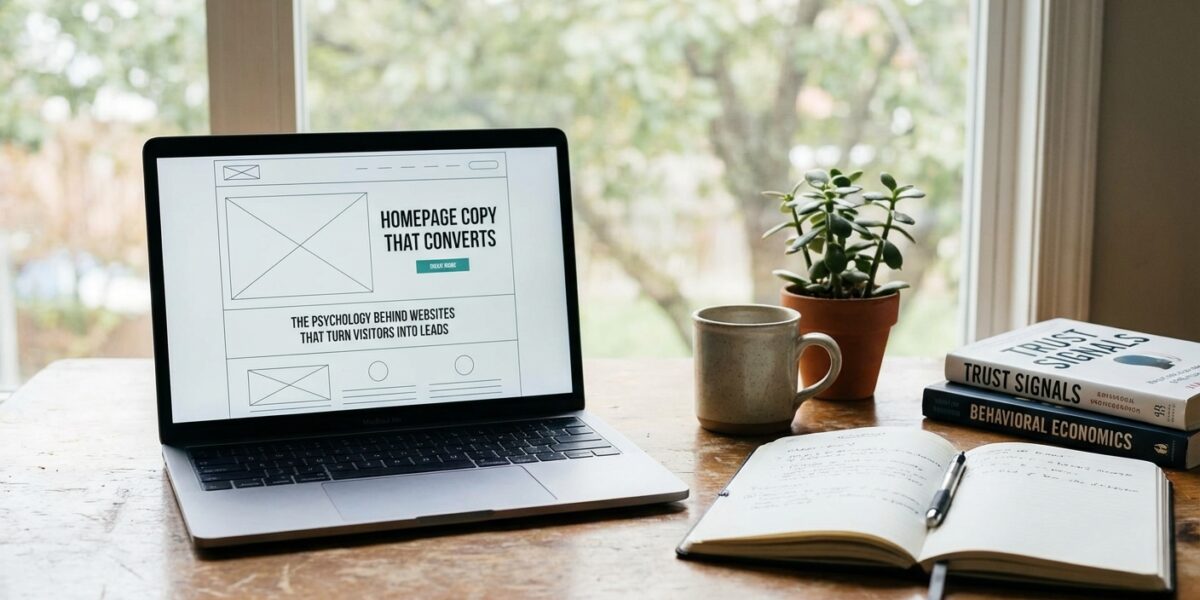
Homepage copywriting — the art and science of writing words on your website’s main page that move visitors toward a specific action — is one of the highest-leverage activities in digital marketing. It sits at the intersection of persuasion psychology, user behavior, and search intent. And most businesses treat it like an afterthought.
I’ve been doing this for over 20 years. I’ve audited hundreds of websites, rewritten dozens of homepages, and watched copy changes produce results that no ad spend could replicate. In this post, I’m going to walk you through the psychology that actually drives homepage conversions — the real mechanisms, not vague platitudes — and give you actionable copy tips you can apply this week.
Why Your Homepage Is Actually a Landing Page (And Should Be Treated Like One)
Here’s a distinction most business owners miss: your homepage isn’t a brochure. It’s not a welcome mat. It’s a decision environment. Every element on it — every headline, every sentence, every button — either moves a visitor closer to converting or pushes them toward the back button.
Unbounce data shows that click-based landing pages (where the goal is to get a click-through) have a median conversion rate of 11.3%, while form-based lead gen pages hit around 4.1%. That’s dramatically higher than the 2–3% average most homepages achieve. The difference? Landing pages are intentionally designed around a single conversion goal. Most homepages are designed around what the business wants to say — not what the visitor needs to hear.
When I audit a homepage, the first question I ask is: Does this page know why someone is here? Visitor intent alignment is the foundation of everything. A person landing on your homepage from an organic search for “commercial AV installation Orlando” has a specific need. If your homepage opens with “Welcome to Our Company” or a vague tagline about passion and excellence, you’ve already lost them.
Treat your homepage like a landing page. Give it one primary conversion goal. Build every copy element around that goal. This single mindset shift changes everything.
Practical takeaway: Define one primary action you want homepage visitors to take — a call, a form fill, a free consultation request. Then audit every headline and paragraph against this question: does this move someone toward that action?
The Headline Is Doing 80% of the Work
David Ogilvy famously said it decades ago, and it’s still true: the headline is read by five times as many people as the body copy. On a homepage, your above-the-fold headline is the first — and sometimes only — thing a visitor processes before deciding to stay or leave.
“On the average, five times as many people read the headline as read the body copy. When you have written your headline, you have spent eighty cents out of your dollar.”
— David Ogilvy, Founder, Ogilvy & Mather
A 2026 copywriting stats compilation found that websites with clear headlines see a 25% higher conversion rate than those with vague or cluttered headlines. That’s not a trivial number. And yet I still see homepages leading with things like “Innovating the Future of Business Solutions” — which tells me absolutely nothing about who you help or what problem you solve.
A strong homepage headline does three things simultaneously: it identifies the visitor (signals this page is for them), it names the outcome they want, and it creates enough curiosity or clarity to make them keep reading. That’s a lot to pack into 8–12 words, but it’s doable.
The formula I come back to most often is: [What you do] + [For whom] + [The primary outcome]. It’s not fancy, but it works because it immediately answers the visitor’s subconscious question: “Am I in the right place?”
Here’s a real example. I worked with a home services company whose headline was “Quality Service You Can Count On.” We rewrote it to “Same-Day HVAC Repair for Central Florida Homeowners — Guaranteed.” Calls went up noticeably within the first two weeks. Same traffic. Different words.
Practical takeaway: A/B test your headline before anything else. Use a tool like Google Optimize (or even a simple time-based test) to compare your current headline against a version that names the visitor, their problem, and your outcome. Give it 30 days and enough traffic to be meaningful.
Benefit-Focused Copy vs. Feature-Focused Copy — This Is Where Most Sites Fail
This is the single most common mistake I see in homepage copy, and it shows up across every industry — from SaaS to local service businesses to e-commerce. Companies write about themselves. Their technology, their process, their certifications, their years in business. And visitors glaze over.
According to a 2025 copywriting stats roundup, benefit-focused copy converts 20–40% better than feature-focused copy across multiple test reports. That’s a significant performance gap that most businesses are leaving on the table because they’re too close to their own product to see it.
Here’s the distinction in plain terms: a feature is what something is. A benefit is what it does for the customer. “24/7 customer support” is a feature. “Get help the moment something goes wrong — even at 2am” is a benefit. Same fact, completely different emotional impact.
The psychological mechanism here is well-documented. Humans are fundamentally motivated by moving toward pleasure or away from pain. Features describe your product’s reality. Benefits describe the visitor’s future. And people buy futures, not features.
“People don’t want to buy a quarter-inch drill. They want a quarter-inch hole.”
— Theodore Levitt, Harvard Business School Professor
When I rewrite homepage copy for clients, I use a simple exercise: take every feature statement and ask “So what does that mean for the customer?” Keep asking until you get to an outcome that someone actually cares about. That’s your benefit.
The research also supports using voice-of-customer (VOC) language — the exact words and phrases your actual customers use to describe their problems and desired outcomes. Rewriting landing pages in VOC language has been shown to boost conversions by 2–5x in multiple documented cases. The reason is simple: when visitors read words that mirror their own internal monologue, they feel understood. And people buy from people (and businesses) who understand them.
Practical takeaway: Pull language from your customer reviews, sales call recordings, and support tickets. Look for the exact phrases customers use to describe their problem and the outcome they wanted. Weave those phrases directly into your homepage copy. This isn’t manipulation — it’s speaking their language.
Social Proof Isn’t Just Nice to Have — It’s a Cognitive Shortcut
Here’s something I’ve noticed over 20 years of watching visitor behavior: people don’t trust what you say about yourself. They trust what other people say about you. This isn’t cynicism — it’s how human cognition works. We’re wired to look to others for cues about what’s safe and valuable, especially in uncertain situations. Psychologists call this social proof, and it’s one of the most powerful forces in conversion psychology.
On a homepage, social proof takes multiple forms: customer testimonials, case studies, review counts, logos of recognizable clients, media mentions, certifications, and trust badges. The key is specificity. Vague testimonials like “Great company, highly recommend!” carry almost no persuasive weight. Specific testimonials that name a problem, describe the experience, and call out a concrete result are dramatically more effective.
Consider the difference between these two testimonials:
- “Amazing service, would definitely use again!” — Sarah M.
- “Our HVAC went out on a Friday night in August. They had a technician at our house by 9pm and the system was running again before midnight. Worth every penny.” — Sarah M., Orlando
The second one does the selling for you. It names the scenario (Friday night emergency), the specificity (9pm response, fixed before midnight), and the emotional resolution (worth every penny). That’s the kind of social proof that moves visitors.
Placement matters too. Don’t bury testimonials at the bottom of your homepage where only the most committed visitors scroll. Place proof elements near your primary CTA, near your pricing section if you have one, and near any point in the page where a visitor might hesitate. Think of social proof as friction-reducers — they go wherever doubt might creep in.
If you’re working on building a review pipeline, I wrote about how to build a review generation system that runs on autopilot — that post will help you get more of the raw material you need for strong social proof.
Practical takeaway: Audit your current testimonials. If they’re generic, go back to your best customers and ask them to answer three specific questions: What was the problem before you hired us? What happened after? What would you tell someone who’s on the fence? Those answers will give you testimonial gold.
Friction-Free CTAs: The Last Inch That Kills Most Conversions
You can do everything else right — clear headline, benefit-focused copy, strong social proof — and still lose the conversion at the call-to-action. CTAs are where the psychological rubber meets the road, and most businesses get them wrong in the same predictable ways.
The most common CTA mistakes I see: using friction words (“Submit,” “Buy Now,” “Sign Up”), making the CTA button vague (“Click Here,” “Learn More”), and creating too much perceived risk around the action. Research from a 2025 copywriting stats roundup found that replacing friction words like “buy” or “sign up” with value-oriented alternatives can increase clicks by approximately 14%. That’s a meaningful lift from a word change.
The psychology behind this is risk perception. Every CTA asks the visitor to make a micro-commitment. The higher the perceived risk or effort, the more resistance they feel. Your job is to make the next step feel safe, easy, and clearly valuable. “Get My Free Quote” beats “Submit.” “Start My Free Trial” beats “Sign Up.” “See How It Works” beats “Learn More.” Each of these shifts frames the action around what the visitor gets, not what they give.
Cognitive load is the other CTA killer. According to a 2025 copywriting stats roundup, 73% of people skim content rather than read every word. That means if your CTA is buried in a paragraph, surrounded by competing links, or requires the visitor to make multiple decisions at once, many of them will simply not act. One primary CTA per page section. Clear visual hierarchy. Enough white space around it to breathe.
This connects to something I covered in my post on landing page optimization — the principle that reducing choices often increases conversions. Hick’s Law (the more options you present, the longer decisions take) applies directly to homepage design and copy. When you give visitors too many paths, many of them choose none.
And don’t overlook the copy around your CTA button — what’s sometimes called the “CTA support copy.” A single line of text directly below or above your button that addresses the biggest objection or reduces risk can meaningfully improve click-through. Something like “No credit card required” or “Free 30-minute consultation — no obligation” takes the perceived risk down a notch right at the moment of decision.
For a deeper look at how copy psychology applies across paid channels, my post on the psychology of PPC ad copy covers a lot of the same persuasion principles in a different context.
Practical takeaway: Rewrite every CTA on your homepage using this template: [Action verb] + [What they get] + [Risk reducer if needed]. “Get My Free Website Audit — No Commitment Required” is infinitely more compelling than “Contact Us.”
The Angle Most Competitors Miss: Cognitive Load Is a Conversion Killer
I want to address something that rarely gets covered in homepage copy posts, and it’s something I’ve seen derail otherwise solid pages: cognitive overload. This is the state where a visitor’s brain is processing so much information — competing headlines, too many options, dense paragraphs, jargon — that the easiest decision becomes leaving.
The research is clear that 73% of people skim. That’s not laziness — that’s how human attention works when we’re evaluating an unfamiliar page. Skimmers are looking for signals: Does this apply to me? Can I trust these people? What do they want me to do next? If your homepage copy is dense, jargon-heavy, or structured like a corporate brochure, skimmers will never get those signals.
The fix isn’t just writing shorter sentences (though that helps). It’s about information architecture — how you sequence your copy so that each section answers one question and creates one forward pull. The pattern I use: open with who this is for and what outcome you deliver, follow with why you’re credible, then address the main objection, then present the offer, then make the ask. Every section earns the next one.
Marketers often focus on adding more — more testimonials, more features, more trust signals — when the real lever is subtracting. Cut every sentence that doesn’t directly serve the visitor’s decision-making process. Your homepage should feel effortless to navigate, not exhausting.
Practical takeaway: Print out your homepage copy (just the text, no design) and read it cold. Highlight every sentence that directly helps a visitor decide whether to take your primary action. Everything that isn’t highlighted is a candidate for cutting or rewriting.
Resources
- Blogging Wizard: Conversion Rate Statistics (2024 Ruler Analytics data) — Industry benchmarks and traffic source conversion rates
- First Page Sage: Conversion Rate by Traffic Source (2025) — B2B and B2C conversion benchmarks by channel
- Unbounce: Landing Page Conversion Benchmarks — Click-based vs. form-based landing page performance data
- Nielsen Norman Group: How Users Read on the Web — Research on scanning behavior and content consumption patterns
- CXL: Copywriting for Conversions — Evidence-based frameworks for persuasive web copy
The Bottom Line
Homepage copywriting isn’t about being clever or creative. It’s about being clear. Clear about who you serve, what outcome you deliver, why you’re credible, and what the visitor should do next. Every psychological principle I’ve covered here — intent alignment, benefit-focused language, social proof, friction-free CTAs, reduced cognitive load — serves that one goal: making it easy for the right visitor to say yes.
The data backs this up. A 2025 stat roundup found that 45% of marketers say copy quality is the biggest factor in conversion rates — above design, targeting, or channel. That’s a remarkable finding. It means your words matter more than your color palette. More than your ad budget. More than your funnel structure.
If your homepage is converting at 2–3%, there’s a very good chance the words on it are the primary constraint. And words are fixable. Start with your headline. Then your primary CTA. Then your testimonials. Run those three changes and measure for 30 days. I’d be surprised if you didn’t see a meaningful lift.
Your next step: Do a homepage copy audit this week using the framework in this post. If you’d like a second set of eyes, my CRO guide for service business websites walks through the full evaluation process. And if you want to understand how copy psychology applies to your paid traffic, start with the psychology of PPC ad copy — the principles overlap more than most people realize.
Frequently Asked Questions
What is homepage copywriting?
Homepage copywriting is the practice of writing the text on a website’s main page with the specific goal of converting visitors into leads, customers, or subscribers. It encompasses the headline, subheadlines, body copy, calls-to-action, and supporting elements like testimonials — all structured to guide a visitor toward a defined action.
How long should homepage copy be?
There’s no universal answer, but homepage copy should be exactly as long as it needs to be to answer the visitor’s key questions and move them to action — no longer. For most service businesses, this means a clear hero section, 2–3 supporting sections covering benefits and proof, and a prominent CTA. Avoid padding. Every paragraph should earn its place.
What’s the biggest mistake businesses make with homepage copy?
Writing about themselves instead of the customer. Most homepages lead with company history, awards, and features — none of which the visitor cares about until they’ve decided you can solve their problem. Lead with the visitor’s outcome, then earn the right to talk about your credentials.
How do I know if my homepage copy is working?
Track your homepage conversion rate in Google Analytics 4 by setting up a goal or conversion event tied to your primary CTA (form submission, phone call, etc.). If your homepage is converting below 2%, there’s almost certainly a copy issue. Use heatmaps (tools like Hotjar or Microsoft Clarity) to see where visitors drop off, and use that data to prioritize what to rewrite first.