

If you’ve been building AI agents for any length of time, you’ve probably hit the same wall I did: your agent is smart, but it has the memory of a goldfish. It can’t connect the dots between what it learned last week and what a user is asking right now. The usual fix is to bolt on a vector database for semantic search, then wire up a separate graph database for relational context, then pray that the sync layer between them doesn’t fail in production. It’s a mess.
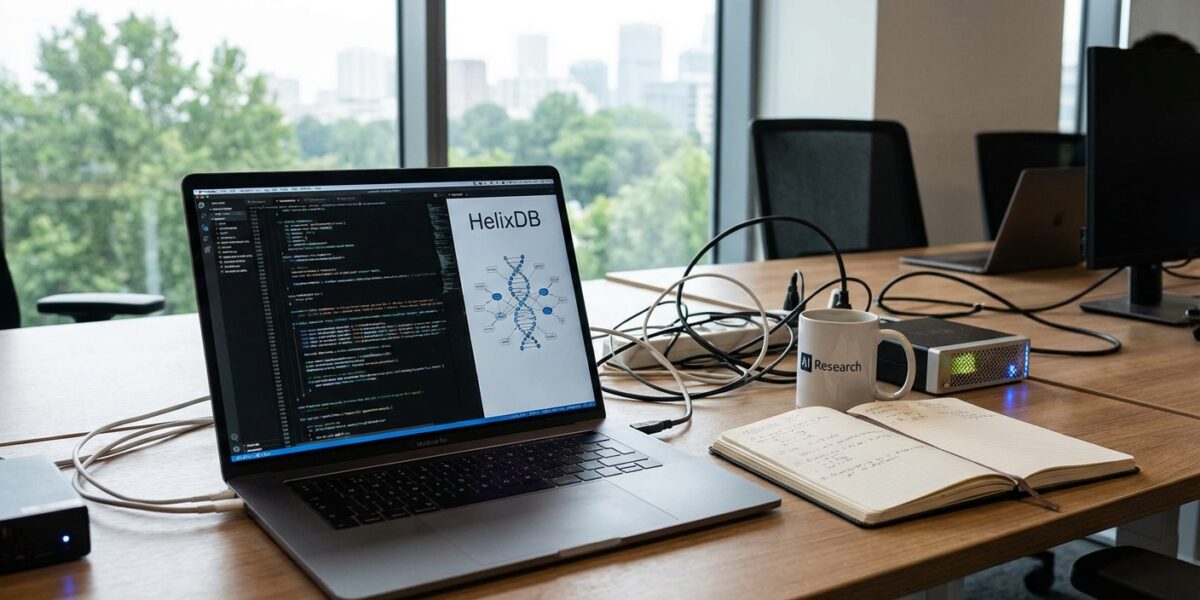
That’s exactly the problem HelixDB is trying to solve. HelixDB is an open-source, OLTP (Online Transaction Processing) graph-vector database built entirely in Rust that combines vector similarity search, graph traversal, and transactional workloads inside a single unified system. No separate databases. No complex joins across systems. No sync layers that break at 2 AM.
I’ve been watching this project closely, and I want to give you an honest breakdown of what it is, how it actually works, why it matters for AI agent memory architecture, and where I think it fits in a real production stack. I also covered a related piece on vector databases generally — check out my post on Qdrant and what a vector database actually is if you need that foundational context first.
What Is HelixDB and Why Does the Architecture Matter
Let’s start with the core entity here. HelixDB is not just another vector store with a graph layer slapped on top. It’s built from the ground up as a unified OLTP engine, using LMDB (Lightning Memory-Mapped Database) for data persistence. LMDB is a well-proven embedded key-value store known for extremely low read latency and ACID compliance — meaning your data is consistent, your transactions are durable, and you’re not trading reliability for speed.
The reason the architecture matters is this: most teams building RAG pipelines or agent memory systems today are running at least two separate data stores. You’ve got a vector database like Qdrant or Pinecone handling semantic similarity, and something like Neo4j or a relational DB handling structured relationships. Every query that needs both — and most interesting agent queries do — requires you to hit both systems, reconcile the results, and hope nothing drifted out of sync. That’s latency, complexity, and a failure surface you didn’t need.
HelixDB collapses that into one system. Graph traversal and vector similarity search happen in the same query, against the same data, with ACID guarantees underneath. For AI agent memory specifically, this is significant because agents need to answer questions like: Who is this user, what did they tell me three conversations ago, and which of my stored knowledge chunks are semantically similar to their current question? That’s a graph question and a vector question simultaneously.
Practical takeaway: If your agent architecture currently requires you to maintain separate vector and graph stores, HelixDB is worth evaluating as a consolidation path — especially if latency and sync complexity are already causing you pain.
HelixQL: Type-Safe Queries with Static Analysis
One of the things that caught my attention immediately was HelixDB’s custom query language, HelixQL. This isn’t SQL bolted onto a graph engine. HelixQL is a purpose-built query language with static analysis and type safety built in.
What does that mean in practice? It means query errors get caught at compile time, not at runtime. If you’ve ever had a production agent fail because a malformed database query slipped through to a live environment, you understand why this matters. Static analysis is a developer experience feature that pays dividends in reliability.
HelixQL also includes a built-in Embed function, which handles vector embedding generation natively. Instead of pre-processing your text through a separate embedding model pipeline and then inserting vectors manually, you can embed directly within the query. That’s a meaningful reduction in pipeline steps for RAG implementations.
The security model is also worth noting. HelixDB is described as secure-by-default: private data is only accessible through compiled queries, not through ad hoc access. For anyone building multi-tenant agent systems where user data isolation matters, that’s not a small thing.
“The real promise of unified graph-vector databases isn’t just performance — it’s that they let you model the world the way it actually is: entities with attributes that relate to each other, discoverable through both meaning and structure.”
— Chet Corcos, former Meta engineer and database researcher, writing on graph-native AI infrastructure
Practical takeaway: HelixQL’s type safety and static analysis make it a better fit for production systems than query languages that fail silently. If you’re prototyping, it feels like more upfront structure. If you’re running in production, it’s the kind of guardrail you’ll thank yourself for later.
Agent Memory Architecture: Where HelixDB Actually Shines
This is the section I’m most interested in as someone who has spent the last couple of years building and experimenting with AI agent workflows. I wrote about how I solved the AI memory problem in an earlier post, and the core challenge I kept running into was the disconnect between semantic recall and relational context.
Here’s a concrete example of where HelixDB’s architecture makes a real difference. Imagine you’re building a research assistant agent. A user asks: “Find me professors who work on topics similar to my research interest in neural plasticity, and show me how they’re connected to each other.”
That query has two parts. The vector part: find entities semantically similar to “neural plasticity.” The graph part: traverse the relationships between those entities to surface connections. In a traditional two-database setup, you’d run the vector search, get back a list of professor IDs, then run a separate graph query against those IDs, then merge the results in application code. In HelixDB, that’s a single HelixQL query. The database handles the hybrid traversal natively.
HelixDB also ships with MCP (Model Context Protocol) tools built in, which allows agents to discover and traverse graphs directly. MCP is the emerging standard for how AI agents communicate with external tools and data sources — I covered this in my post on WebMCP and what it means for AI agents. Having MCP support native to the database rather than requiring a custom integration layer is a genuine architectural advantage.
“Agents walking a graph through MCP is one of the most compelling use cases I’ve seen for a database like this — it’s not just retrieval, it’s navigation.”
— Product Hunt community discussion on HelixDB, 2026
Practical takeaway: If you’re building agents that need to do anything more sophisticated than flat document retrieval — user history, entity relationships, knowledge graphs, multi-hop reasoning — HelixDB’s unified model is worth a serious look. The MCP integration in particular is something I’d want to test against a real agent workflow before committing, but the architecture is sound.
The Open-Source Rust Foundation: Performance and Trust
HelixDB being built in Rust is not a marketing bullet point — it’s an architectural decision with real implications. Rust’s memory safety guarantees eliminate entire categories of bugs that plague C and C++ systems: buffer overflows, use-after-free errors, data races in concurrent code. For a database that’s handling AI agent memory at scale, those guarantees matter.
Rust also delivers performance characteristics that are genuinely competitive with C-level systems without the memory management footprint of garbage-collected languages like Go or Java. For a database handling high-frequency OLTP workloads — which is exactly what an AI agent firing queries on every turn represents — that matters.
The open-source nature of the project means you can audit the code, self-host it, and avoid vendor lock-in. That’s a meaningful consideration for teams building on top of AI infrastructure where the data being stored is sensitive user context or proprietary knowledge. I’ve seen too many teams get burned by depending on a managed vector database service that changes its pricing model or gets acquired. Open source gives you an exit ramp.
HelixDB supports multiple data models within the same engine: graph, vector, key-value, document, and relational. That’s a broad surface area for a single system, and I’d want to see independent benchmarks before claiming it beats specialized systems at every workload. But for the specific pattern of graph traversal plus vector similarity in a transactional context, the unified architecture is a legitimate advantage over stitching together purpose-built tools.
Practical takeaway: The Rust foundation and open-source licensing make HelixDB a credible infrastructure choice for teams that care about performance, auditability, and avoiding lock-in. It’s worth spinning up a local instance and running it against your actual query patterns before drawing conclusions.
What HelixDB Is Not (And Why That Matters)
I want to spend a minute on the angle most coverage of HelixDB skips: the honest limitations and open questions.
HelixDB is an OLTP system, not an OLAP (Online Analytical Processing) system. That distinction matters. OLTP is optimized for high-frequency, low-latency reads and writes — exactly what an AI agent firing queries on every conversation turn needs. OLAP is optimized for large-scale analytical queries across massive datasets — think data warehousing and business intelligence. HelixDB is explicitly not trying to be that. If your use case is running complex analytical queries across billions of historical records, HelixDB is the wrong tool.
The project is also relatively young. It reached general availability in 2025, which means the production track record is still being established. Claims of handling “billions of queries” at scale and “infinitely scalable” high availability are marketing language that I’d want to see backed by independent benchmarks and case studies before betting a production system on them. That’s not a knock on the project — it’s just honest due diligence for any new infrastructure tool.
The ecosystem maturity around HelixDB is also still developing. The community is growing on Discord and X, Python tutorials are available, and cloud deployment tooling exists. But compared to established players like Neo4j for graph or Pinecone for vector, the ecosystem of integrations, community answers, and battle-tested deployment patterns is smaller. That’s a real consideration for teams without the bandwidth to be early adopters.
For what it’s worth, I think the architecture is sound and the problem it’s solving is real. I’m watching this project closely, and I’d encourage teams building agent memory systems to at least run a proof of concept. But go in with eyes open about the maturity curve.
If you’re building AI agent workflows and thinking about how memory, retrieval, and tool use all connect, my post on how I use AI agents to supercharge my marketing workflow gives you a practical frame for where database architecture decisions actually show up in real workflows.
Resources
- HelixDB Official Site – Product overview, documentation, and getting started guides
- HelixDB GitHub Repository – Open-source codebase, issues, and community contributions
- HelixDB on Product Hunt – Community reviews and launch discussion threads
- LMDB (Lightning Memory-Mapped Database) – Technical overview of the persistence layer HelixDB is built on
- Model Context Protocol (MCP) – The open standard for AI agent tool integration that HelixDB natively supports
The Bottom Line
HelixDB is solving a real problem. The fragmentation between vector stores and graph databases is a genuine pain point for anyone building serious AI agent systems, and a unified OLTP engine that handles both — with ACID guarantees, type-safe queries, and native MCP support — is a compelling architectural answer.
It’s not a mature, battle-tested system yet. The production track record is still being written. But the foundation is technically sound, the open-source Rust implementation is credible, and the problem it’s targeting is only going to get more pressing as agent memory requirements grow more sophisticated.
My recommendation: if you’re actively building AI agent infrastructure and hitting the sync-layer problem I described at the top, spin up a local HelixDB instance this week and test it against a real query pattern from your stack. Don’t migrate production yet. But don’t ignore it either.
If you want to go deeper on AI agent architecture and the tools I’m actually using in my own workflows, my post on building token-efficient AI systems covers the broader infrastructure picture and where database choices fit into cost and performance optimization.
Have you experimented with HelixDB or another unified graph-vector solution? I’d genuinely love to hear what you’re running into — drop a comment below or reach out directly. This is a space I’m actively exploring and the community knowledge is still being built.
Frequently Asked Questions
What makes HelixDB different from using Pinecone and Neo4j together?
The core difference is architectural. Pinecone and Neo4j are separate systems that require a sync layer and application-level result merging when you need both vector similarity and graph traversal in the same query. HelixDB handles both natively in a single OLTP engine, which reduces latency, eliminates sync complexity, and gives you ACID guarantees across both data models simultaneously.
Is HelixDB production-ready in 2025-2026?
HelixDB reached general availability in 2025, so it is technically production-ready. However, it’s a relatively young project and the independent production track record is still being established. Teams with low tolerance for early-adopter risk should run thorough proof-of-concept testing against their specific workloads before committing to a full production migration.
What programming languages does HelixDB support?
HelixDB is built in Rust internally, but it exposes query capabilities through its custom HelixQL query language. Python tutorials and integrations are available, making it accessible for AI/ML teams that primarily work in Python. The MCP tool support also means agent frameworks that implement the Model Context Protocol can interact with HelixDB natively.
What is agent memory architecture and why does it matter?
Agent memory architecture refers to how an AI agent stores, retrieves, and reasons over information across multiple interactions and knowledge sources. It matters because agents without effective memory architecture can only operate on the current context window — they can’t recall past interactions, connect related concepts across sessions, or build up a persistent model of the user or domain. HelixDB’s graph-vector approach is specifically designed to support the hybrid retrieval patterns that sophisticated agent memory requires.