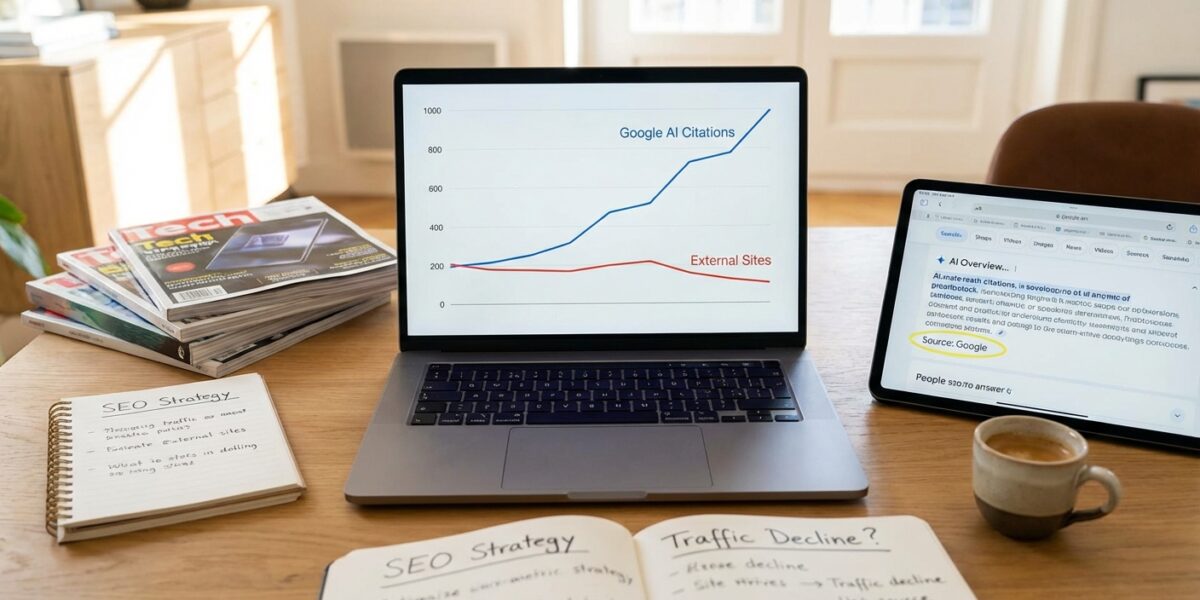
Google’s AI Mode is quietly morphing into a self-referential walled garden. According to a fresh 1.3-million-citation study SE Ranking ran across 68 000 keywords, Google.com is now the single most-cited domain inside AI Mode answers—17.42 % of all citations, up from barely 5 % nine months ago. When you add YouTube (also Google), the company’s share tops 20 %. That’s not an incremental tweak; it’s a traffic pivot that could redefine how much organic reach you actually get.
From 5 % to 17 %: the self-citation timeline
- June–July 2025: ~5 % of AI Mode answers cited Google properties
- February 2026: 1 in 6 answers (17–17.42 %) now link back to Google.com
The search giant has tripled its self-love in less than a year, and the climb shows no sign of slowing.
Where do those self-citations land?
Not every Google link is created equal. The 17 % breaks down as:
- 59 % → classic organic SERPs (yes, rankings still matter)
- 36 % → Google Business Profiles
- 3 % → Flights, Shopping, Hotels, support docs, etc.
Translation: if you’re not on page 1, you’re invisible in both blue-link and AI Mode contexts.
Sector spotlight: travel & entertainment feel the squeeze first
- Travel queries: 53 % of AI Mode citations stay inside Google
- Entertainment / hobbies: 49 %
If you publish hotel round-ups, tour guides, lyrics, game walk-throughs or streaming reviews, AI Mode is already keeping half your potential visitors on Google.com instead of sending them to you.
Why Google is doing this (and won’t stop)
1. Mini-SERP panels keep users inside the interface—prime real estate for ads.
2. Google monetizes its own surfaces (Hotel Ads, Shopping, Maps) without sharing click-through revenue.
3. AI Mode is experimental; Google is testing how little outbound traffic users will accept before they complain.
Industry watchers call it “self-preferencing on steroids.” Expect the share to creep past 20 % by late 2026 unless regulators intervene.
What it means for your organic traffic
- Fewer raw clicks: every percentage point Google keeps is a slice removed from the open web.
- Top-heavy SERPs: position #1 nets a 33 % chance of being pulled into AI Mode versus only 13 % at #10 (Ahrefs data).
- Zero-click searches keep climbing; impressions may rise even as sessions fall—track both KPIs.
5 actions to protect your visibility
1. Double-down on top-10 rankings
E-E-A-T, Core Web Vitals, schema and fresh content are prerequisites, not nice-to-haves.
2. Target conversational, long-tail intents
AI Mode loves FAQ-style questions. Answer them in clear, cite-worthy paragraphs so Google has something better to quote than its own Support page.
3. Optimise your Google Business Profile
36 % of self-citations land here. Keep hours, photos, Q&A and posts updated—especially in travel/entertainment niches.
4. Diversify traffic sources
Email lists, direct, social, YouTube, podcasts and community forums can’t be walled off overnight. Start building owned audiences now.
5. Monitor AI Mode for your keywords
Tools like SE Ranking and ZipTie flag when an AI answer replaces a SERP. Track weekly, note which pages are quoted (or not), and iterate content accordingly.
Common mistakes to avoid
- Ignoring organic SEO because “AI is the future.”
59 % of Google’s self-citations are recycled organic listings—rankings still drive AI inclusion.
- Chasing only viral traffic.
AI Mode rewards authority and clarity, not click-bait.
- Forgetting local.
Even in 2026, 1 in 3 self-citations point to Business Profiles—free real estate you can control today.
Key takeaway
Google AI Mode isn’t killing search—it’s re-routing the exits back to Google. The higher the self-citation rate climbs, the more your classic SEO playbook becomes your AI visibility strategy. Rankings, authority and structured data remain the price of admission; everything else is just noise inside the walled garden. Stay visible, stay useful—and don’t build your house entirely on someone else’s land.
Related reading on this site
- [Google AI Mode Canvas: What It Means for Marketers and Content Strategy](https://www.jonalonso.com/google-ai-mode-canvas-what-it-means-for-marketers-and-content-strategy/)
- [SEO in 2026: What Will Stay the Same (And What You Can Ignore)](https://www.jonalonso.com/seo-in-2026-what-will-stay-the-same-and-what-you-can-ignore/)