

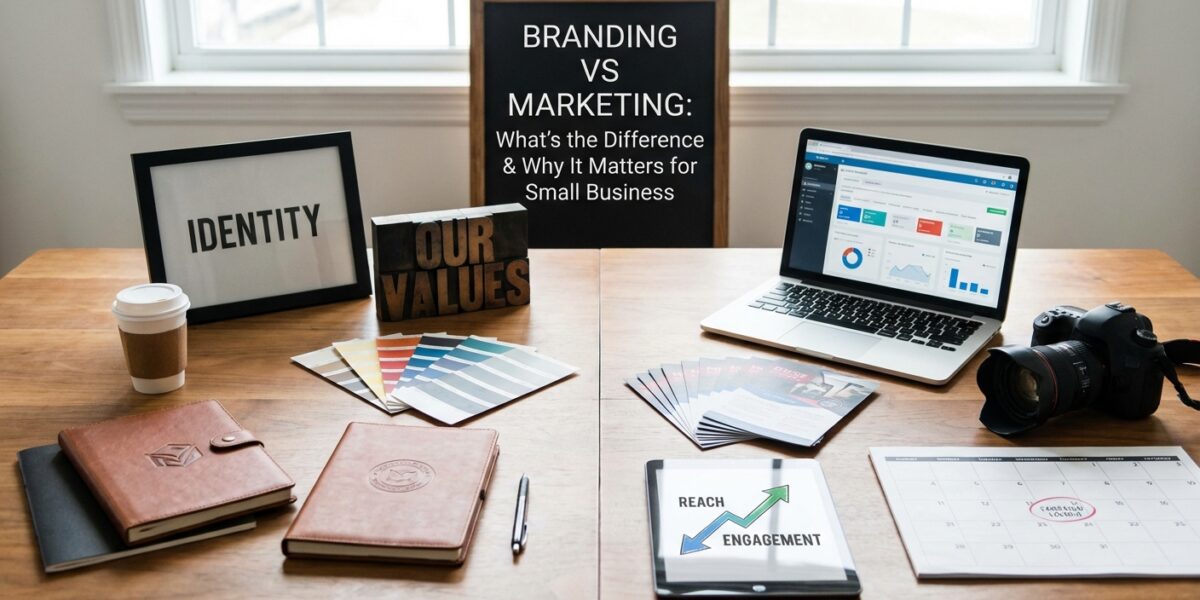
Here’s a mistake I’ve watched small business owners make for over two decades: they pour money into marketing before they’ve done a lick of branding work. Then they wonder why their ads aren’t converting, why customers don’t come back, and why they’re constantly competing on price. The root cause, almost every time, comes down to one misunderstood distinction — branding vs marketing.
The confusion between branding vs marketing isn’t just semantic — it’s costing real businesses real money every single day. And the fix isn’t complicated, but it does require understanding what each one actually is and how they work together.
In this post, I’m going to break down the real difference between branding and marketing, explain why small business branding has to come first, and give you a practical path to building both in a way that actually compounds over time.
Branding and Marketing Are Not the Same Thing
Let me give you the clearest definitions I know. Branding is who you are — your identity, values, positioning, voice, and the emotional experience people have when they interact with your business. Marketing is how you get seen — the tactics, channels, campaigns, and messages you use to drive awareness, leads, and sales.
Think of it this way: your brand is the stage. Your marketing is the performance. If the stage is shaky and undefined, the performance suffers no matter how talented the performers are.
Brand identity — the visual and verbal system that represents your brand (logo, colors, typography, tone of voice, tagline) — is one of the most searchable and misunderstood concepts in small business marketing. People think brand identity is just a logo. It’s not. It’s the entire sensory and emotional fingerprint of your business. A well-developed brand identity gives your customers something consistent to recognize, trust, and return to — and it gives your marketing materials a cohesive foundation to build from.
Marketing, on the other hand, is time-bound and tactical. A Google Ads campaign runs for a quarter. A social media push lasts a few weeks. SEO content targets specific queries. These are all marketing activities. They drive short-to-medium term results. Branding is the long game that makes every one of those tactics more effective and less expensive. When you understand the full picture of branding vs marketing, the sequencing becomes obvious: brand first, then market.
Why Small Businesses Get Branding vs Marketing Backwards
I get it. When you’re running a small business, you need revenue now. So you jump straight into marketing — run some Facebook ads, post on Instagram, maybe throw some money at Google. And sometimes it works, at least a little. But here’s what’s actually happening under the hood.
Without a clear brand, your marketing has no anchor. Every ad you run has to work harder to earn trust from scratch. Every new customer you acquire costs more because there’s no recognition, no reputation, no emotional pull. According to research cited by Harvard Business Review, acquiring a new customer is 5 to 25 times more expensive than retaining an existing one. Weak small business branding directly contributes to poor retention because customers have nothing to be loyal to.
I’ve worked with dozens of small businesses here in Central Florida over the years. The pattern is almost always the same: they’ve been running marketing campaigns for months, sometimes years, with mediocre results. We dig in and discover there’s no coherent brand underneath any of it. No consistent brand identity. No clear positioning. No emotional reason for a customer to choose them over the competitor down the street.
When we fix the brand first, the marketing starts working better almost immediately — not because we changed the tactics, but because now the tactics have something real to amplify.
“Branding defines differentiation, marketing amplifies it.”
— David Brier, Brand Strategist and Author of The Lucky Brand
That quote from David Brier nails the branding vs marketing relationship perfectly. If you don’t have differentiation baked into your brand, your marketing is just noise. And in a saturated local market, noise gets ignored.
What Strong Brand Identity Does for Your Marketing ROI
This is the part most marketing conversations skip over, and it’s the part that matters most for small businesses with limited budgets.
Strong small business branding reduces your customer acquisition cost over time. When people recognize your brand identity, trust it, and feel emotionally connected to it, they convert faster, refer more often, and stay longer. That means every dollar you spend on marketing goes further.
Look at Nike. Their Air Jordans retail around $190. A comparable athletic shoe from a lesser-known brand sells for a fraction of that. The product difference doesn’t justify a $100+ price gap — the brand does. That’s pricing power, and it’s 100% a function of branding, not marketing.
Now, you’re not Nike. But the principle scales down perfectly. A local HVAC company with strong small business branding — clear positioning, consistent visuals, a recognizable voice, and a reputation for specific values — can charge more than the generic competitor. Their Google Ads get better click-through rates because people recognize the name. Their reviews are more enthusiastic because customers feel connected to something. Their referral rate is higher because there’s a story worth telling.
This is the core lesson in the branding vs marketing conversation that most small business owners miss: brand identity is an investment that makes your marketing budget work harder. It’s not a luxury for big companies. It’s a multiplier for small ones.
The Right Order: Small Business Branding Before Marketing Tactics
So what does this look like practically? Here’s the hierarchy I use with every client, regardless of size or industry.
Step 1: Brand strategy. This is your positioning (who you serve, what problem you solve, why you’re different), your core values, your brand voice, and your promise to customers. This is the strategic foundation of all effective small business branding. It doesn’t take months. A focused small business can nail a Minimum Viable Brand — what some strategists call an MVB — in two to four weeks.
Step 2: Brand identity. Once str