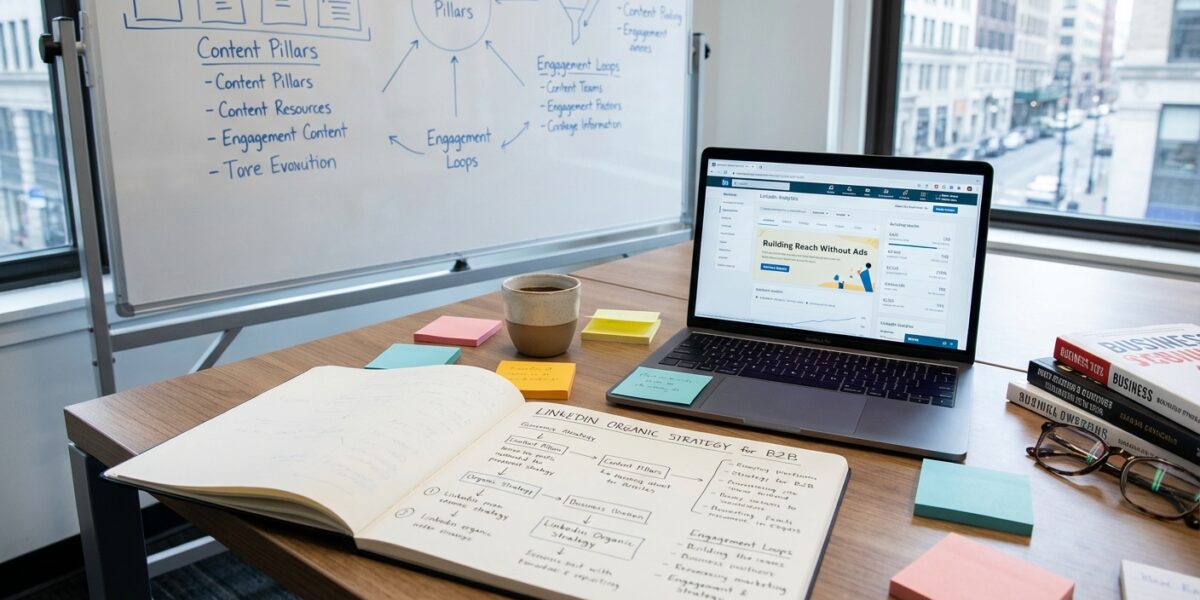
A LinkedIn organic strategy is the deliberate, systematic approach to building visibility, credibility, and pipeline on LinkedIn without relying on paid advertising. It encompasses your content cadence, profile optimization, engagement habits, and the relationships you cultivate — all working together to get your message in front of decision-makers who actually have buying authority. For B2B marketers serious about LinkedIn B2B marketing in 2026, this foundation is non-negotiable.
I’ve been doing B2B marketing for over two decades, and I’ll be honest: LinkedIn used to be an afterthought for most of my clients. They’d post a company update once a month and wonder why nothing happened. That’s changed dramatically. Today, LinkedIn is the single most important organic channel for B2B marketers who want to reach real buyers — and if you’re not treating it seriously, you’re leaving pipeline on the table.
Let me show you what actually works in 2026, what the algorithm is rewarding right now, and the mistakes I see B2B teams make over and over again.
Why LinkedIn Organic Still Matters for B2B Marketing (Even With Declining Reach)
Yes, organic reach has dropped. I’m not going to sugarcoat that. Some B2B accounts have seen reach fall by as much as 5-7x compared to two years ago. But here’s the thing — the quality of the audience that does see your content has improved significantly because the algorithm has gotten better at matching content to high-intent professionals. That’s a critical distinction for any LinkedIn B2B marketing effort built on organic growth.
LinkedIn generates somewhere between 75-85% of all B2B leads from social media, according to data aggregated by Cognism and GrackerAI in 2025-2026 analyses. That’s not a number you can ignore. The platform has 1.3 billion total members and over 600 million monthly active users, with 93% of B2B marketers already using it as part of their LinkedIn content strategy.
What really gets my attention is the conversion data. LinkedIn’s visitor-to-lead conversion rate sits at 2.74% — that’s 3-4x higher than Facebook (0.77%) or Twitter (0.69%). And LinkedIn’s cost per lead runs 28% lower than Google Ads, even on the paid side. Organically, you’re essentially getting access to that same high-intent audience for free, as long as your content earns it.
"Our LinkedIn reach dropped 5-7x compared to two years ago, but pipeline quality improved 20x."
— FullFunnel.io, B2B Revenue Marketing Agency
That quote from FullFunnel.io captures exactly what I’ve observed with my own clients. Less reach, better results. The algorithm is forcing a quality-over-quantity shift, and that’s actually good news for marketers willing to invest in a serious LinkedIn organic strategy.
How the 2026 LinkedIn Algorithm Actually Works
The 2026 algorithm update made some meaningful shifts that you need to understand before you post another word. LinkedIn has moved decisively away from rewarding broad reach and viral-style broadcasting. It now prioritizes authentic engagement, personal connections, and content that generates real conversation — which has major implications for your LinkedIn reach in 2026.
Here’s what the algorithm is currently rewarding:
- Early engagement velocity: The first 60-90 minutes after posting matter enormously. If your post gets meaningful comments quickly, LinkedIn pushes it to a wider audience. If it sits there with only likes, it gets buried.
- Comment quality over like quantity: A post with 15 substantive comments outperforms one with 200 likes and 3 comments. The algorithm reads engagement depth, not just volume — a key insight for any LinkedIn content strategy.
- Personal profiles over company pages: This one still surprises clients. Your personal LinkedIn profile will almost always outperform your company page organically. People connect with people, not logos.
- Native content: LinkedIn actively suppresses external links in posts. If you must share a link, put it in the first comment and reference it in the post body.
- Video and carousels: Carousel posts currently achieve the highest engagement rate at 6.60% according to ContentIn data. Video is used by 78% of B2B marketers and is getting strong algorithmic support in 2026.
One thing I tell every client building a LinkedIn B2B marketing program: stop treating LinkedIn like a broadcast channel. The algorithm is explicitly designed to reward conversation, not announcements.
The Content Formats That Drive LinkedIn Organic Reach in 2026
Carousels (Your Highest-Leverage Format for LinkedIn Content Strategy)
Carousel posts — those multi-slide PDF documents you upload directly to LinkedIn — are pulling a 6.60% engagement rate right now. That’s not a typo. For context, most social media platforms are thrilled with 1-2% engagement. Carousels work because they encourage swipe-through behavior, which signals deep engagement to the algorithm and dramatically extends your LinkedIn organic reach.
My approach: create carousels that teach something specific in 7-10 slides. Not a sales pitch. A genuine how-to, a framework, a comparison. The last slide can have a soft CTA, but the value has to be real throughout.
Short-Form Video
LinkedIn’s push into video is real and it’s working. You don’t need a production studio. What you need is a clear point, decent lighting, and the willingness to talk on camera. I’ve seen 90-second videos from founders explaining a single business concept outperform polished brand videos by a wide margin — and they’re one of the most underused assets in most LinkedIn B2B marketing playbooks.
Keep it under 3 minutes. Get to the point in the first 5 seconds. Add captions — most people watch without sound.
Text Posts With a Strong Hook
Don’t underestimate a well-written text post as part of your LinkedIn content strategy. The hook — your first line — determines whether someone clicks "see more" or scrolls past. I spend more time on the first line than on the rest of the post combined. It should create tension, curiosity, or a strong opinion. Not "Excited to share that…"
Polls (Used Sparingly)
Polls generate comments and votes, which the algorithm loves. But they’ve been overused. Use them when you have a genuinely interesting question that your B2B audience will actually have a stake in answering — not as a cheap engagement hack that undermines your broader LinkedIn organic strategy.