

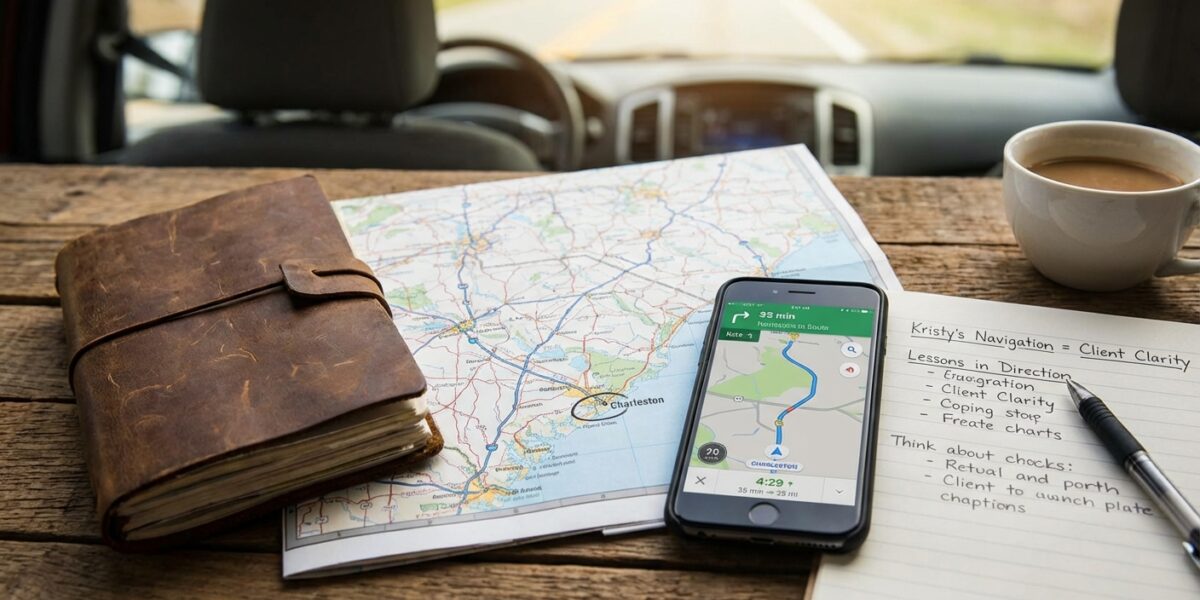
Last month, Kristy and I took a spontaneous road trip to Charleston, South Carolina. What started as a weekend getaway turned into one of the most valuable lessons I’ve learned about client communication in years. And it all came down to how she navigates.
I’m the type who programs the GPS, follows the blue line, and gets frustrated when Siri reroutes me. Kristy? She reads the road like it’s a conversation.
The Navigator Who Actually Listens
About thirty minutes into our drive, I noticed something. Every time I mentioned wanting to stop for coffee, or pointed out an interesting exit, Kristy was already looking at options on her phone. Not interrupting me. Not dismissing my ideas. Just quietly adjusting our route to accommodate what I was actually saying.
She wasn’t just hearing me—she was listening. And that’s when it hit me: this is exactly what most of us get wrong with client communication.
We hear the words. We nod along. But we’re already planning our response, our solution, our pitch. We’re following our predetermined GPS route instead of reading the actual road in front of us.
The Difference Between Hearing and Listening
According to research from UCLA Anderson, there’s a significant gap between how well speakers think they’re being heard and how well listeners are actually paying attention. We assume we’re communicating clearly, while our audience might be mentally checked out.
I see this constantly in marketing consultations. A client will mention their real concern—maybe it’s budget anxiety, or fear of looking outdated—and the consultant barrels ahead with their standard pitch deck. They heard the words but missed the meaning.
Kristy’s navigation style is different. When I said “I’m getting hungry,” she didn’t just acknowledge it and keep driving. She started looking at restaurant options near our route, checking reviews, and asking follow-up questions about what I was in the mood for.
Active Listening in Action
Harvard Business Review has documented how active listening transforms professional relationships. It’s not a passive activity—it requires effort, attention, and genuine curiosity about what the other person needs.
On that Charleston trip, Kristy demonstrated three specific behaviors that I now recognize as essential client communication skills:
- She acknowledged what I said immediately — “You mentioned coffee” or “I heard you say you’re hungry”
- She asked clarifying questions — “Do you want to stop now or can you wait thirty minutes?”
- She adjusted the plan based on my actual needs — not what she assumed I needed
These seem obvious when I write them out. But how many client calls have you been on where the agency or consultant does none of these things?
The GPS Mentality vs. The Road Reader
Here’s what I realized about my own communication style: I was operating like a GPS. Input the destination, calculate the optimal route, ignore all deviations. Efficient? Sure. Effective? Not always.
Clients don’t need a GPS. They need a navigator who reads the road—someone who notices when they’re uncomfortable with a recommendation, who picks up on budget concerns they haven’t explicitly stated, who adjusts the strategy when market conditions change.
During our Charleston trip, we hit unexpected traffic on I-95. My instinct was frustration—this wasn’t part of the plan. Kristy’s response? She found a scenic backroad that added fifteen minutes but took us through a small town with a fantastic barbecue spot we never would have discovered otherwise.
Flexibility Is a Communication Skill
The best client relationships I’ve built over twenty years in SEO have one thing in common: flexibility grounded in listening. Not flexibility that means “we have no strategy”—but flexibility that means “we’re paying attention to what’s actually happening.”
When a client says their rankings dropped, I could follow my standard diagnostic checklist (the GPS approach). Or I could ask questions, listen to their specific concerns, and adjust my investigation based on what they’re actually experiencing (the road reader approach).
Most of the time, the second approach uncovers issues the checklist would have missed. Just like Kristy’s navigation uncovered that barbecue spot my GPS never would have found.
What Charleston Traffic Taught Me About Client Expectations
The traffic jam on I-95 created an interesting dynamic. I was stressed because we were “behind schedule.” But Kristy asked a simple question: “What schedule? We’re on vacation.”
She was right. I’d created an arbitrary timeline in my head and was treating it like a client deadline. The stress was self-imposed.
This happens in client communication all the time. We create expectations—often unspoken ones—and then get frustrated when reality doesn’t cooperate. The client thinks we’re going to rank them #1 in thirty days. We think they understand SEO takes six months. Nobody actually clarified expectations, so everyone ends up disappointed.
Setting Expectations Through Questions
Kristy’s navigation style includes constant expectation-setting. “We’ll hit traffic around Jacksonville—do you want to leave earlier or just plan for it?” “This route is faster but has tolls—which do you prefer?”
She’s not making assumptions. She’s asking questions and letting me participate in the decision-making process. When I feel heard and included, I’m way more patient when things don’t go perfectly.
The same principle applies to client communication. When clients understand why we’re recommending a strategy, what the realistic timeline looks like, and what trade-offs we’re making, they’re infinitely more patient when results take time.
According to recent customer service research from Nextiva, 61% of customers now prefer digital communication channels, but complex issues still require real conversation. The key isn’t the channel—it’s whether you’re actually listening and setting clear expectations.
The Parallel Parking Moment
We finally arrived in Charleston and immediately faced the most stressful part of any road trip: finding parking in a historic downtown with streets designed for horses, not SUVs.
I spotted a space that looked tight. My instinct was to keep driving and find something easier. Kristy said, “I think you can make it—want me to get out and guide you?”
That moment crystallized everything. She wasn’t telling me what to do. She wasn’t taking over. She was offering support while letting me stay in control. And because she’d been listening to me all day, I trusted her guidance.
That’s the relationship every consultant should build with clients. Not “let me take over your marketing”—but “I’ll guide you, support you, and help you see angles you might miss, while you stay in control of your business.”
Trust Built Through Consistent Listening
I trusted Kristy’s parking guidance because she’d demonstrated all day that she was paying attention to my needs. She’d earned that trust through consistent, active listening.
Client trust works the same way. It’s not built through one great proposal or one successful campaign. It’s built through consistent demonstration that you’re actually listening—that you hear their concerns, adjust to their needs, and guide them without steamrolling them.
I’ve lost clients not because my SEO strategies didn’t work, but because I wasn’t listening closely enough to what they actually needed. Maybe they needed more frequent communication. Maybe they needed simpler reporting. Maybe they needed reassurance more than data.
The strategy was fine. The listening was lacking.
Bringing It Back to Your Client Relationships
So what does Kristy’s navigation style actually teach us about client communication? Here’s what I’m implementing based on that Charleston road trip:
Stop following the GPS blindly. Your standard process is valuable, but every client is different. Read the road in front of you, not just the route you planned last week.
Acknowledge what clients say immediately. Even if you can’t solve their problem right now, let them know you heard them. “I understand you’re concerned about the timeline—let me look at options” goes a long way.
Ask clarifying questions before proposing solutions. When a client says they want “more traffic,” dig deeper. What kind of traffic? For what purpose? What does success actually look like to them?
Build flexibility into your strategy. The best plan is worthless if you’re not willing to adjust when conditions change. Be the navigator who finds the scenic backroad, not the GPS that keeps recalculating the same blocked route.
Set expectations through conversation, not assumption. Don’t assume clients understand timelines, processes, or trade-offs. Ask questions. Explain options. Let them participate in decisions.
These aren’t revolutionary ideas. But like Kristy’s navigation style, they’re simple behaviors that most of us don’t consistently practice. We get busy, we default to efficiency over effectiveness, and we stop actually listening.
The Return Trip
The drive home from Charleston was completely different than the drive there. I found myself naturally adopting Kristy’s navigation approach—asking questions, staying flexible, reading the road instead of just following directions.
We made better time, had more fun, and I was way less stressed. Not because the traffic was lighter or the route was shorter, but because I was actually present in the moment instead of rigidly following a plan.
That’s what good client communication feels like. It’s not more efficient in the short term—active listening takes time. But it’s infinitely more effective. Clients feel heard, trust builds naturally, and you end up solving the right problems instead of the ones you assumed existed.
If you want to dive deeper into communication strategies that actually work, I wrote about what Kristy taught me about marketing in a previous post. The principles overlap significantly—whether it’s navigation, marketing, or client relationships, listening is the foundation.
What I’m Changing
Since that Charleston trip, I’ve made specific changes to how I communicate with clients. I’m scheduling longer discovery calls with more open-ended questions. I’m building more flexibility into project timelines. I’m acknowledging concerns immediately instead of waiting until I have a complete solution.
Most importantly, I’m treating client communication like Kristy treats navigation: as an active, ongoing conversation rather than a one-time route calculation.
The results have been noticeable. Clients are more engaged, more patient with timelines, and more likely to bring up concerns early instead of letting them fester. Not because my SEO strategies changed, but because the communication around those strategies improved.
For more insights on building better client relationships through strategic communication, check out resources from Harvard Business Review on active listening and Slack’s research on empathetic workplace communication. The principles apply whether you’re navigating to Charleston or navigating client expectations.
Your Turn
Think about your last difficult client conversation. Were you following the GPS—sticking to your predetermined plan despite signals that something wasn’t working? Or were you reading the road—picking up on concerns, asking questions, and adjusting your approach?
Most of us default to GPS mode when we’re busy or stressed. It feels more efficient. But efficiency in communication often means missing the insights that matter most.
The next time you’re in a client meeting, try Kristy’s navigation approach. Listen actively. Ask clarifying questions. Acknowledge concerns immediately. Build flexibility into your recommendations. Treat the conversation like a road trip where the journey matters as much as the destination.
You might be surprised how much it changes the relationship. I know I was.
Want to improve how you communicate with clients? Start by examining your own listening habits. Are you hearing words or understanding meaning? Are you following a script or reading the road? The difference between good and great client relationships often comes down to that distinction. If you found this helpful, check out my post on sales psychology in digital marketing—it covers similar ground from a different angle.
Frequently Asked Questions
How can I tell if I’m really listening to clients or just hearing them?
Ask yourself: Can you summarize their concern in their own words, not yours? Are you asking clarifying questions before proposing solutions? If you’re immediately jumping to your standard response, you’re probably hearing but not listening. Real listening involves pausing, reflecting back what you heard, and confirming understanding before moving forward.
What’s the difference between being flexible and having no strategy?
Flexibility means you have a strong strategy but you’re willing to adjust tactics based on real-world feedback and changing conditions. No strategy means you’re reactive to every request without a guiding framework. Think of it like navigation: you know the destination (strategy) but you’re willing to take a different route (tactics) when conditions require it.
How do I balance active listening with efficiency when I have dozens of clients?
Active listening actually saves time in the long run because you solve the right problems the first time. But practically, focus your deep listening on discovery calls, quarterly reviews, and moments when clients express concern. For routine updates, you can be more efficient—but always leave space for clients to raise issues. Even five minutes of genuine listening can prevent hours of misaligned work.
What should I do when a client’s expectations are unrealistic despite good communication?
Use the navigation analogy directly. “You want to get to Charleston by 2pm, but there’s construction and traffic—we can push our speed and arrive stressed, find a different route that takes longer but is more pleasant, or adjust our arrival time. Which matters most to you?” Frame it as trade-offs, not limitations. Most clients are reasonable when they understand the actual options and constraints.