As you read this, Cubans are in the streets.
Every single day since March 6, they’ve been protesting — Havana, Santiago de Cuba, Matanzas, Morón. The lights are out for twenty hours a day. People are burning portraits of the Revolution. And the regime’s Red Berets are marching in.
This isn’t just news to me. It’s family history, playing out in real time.
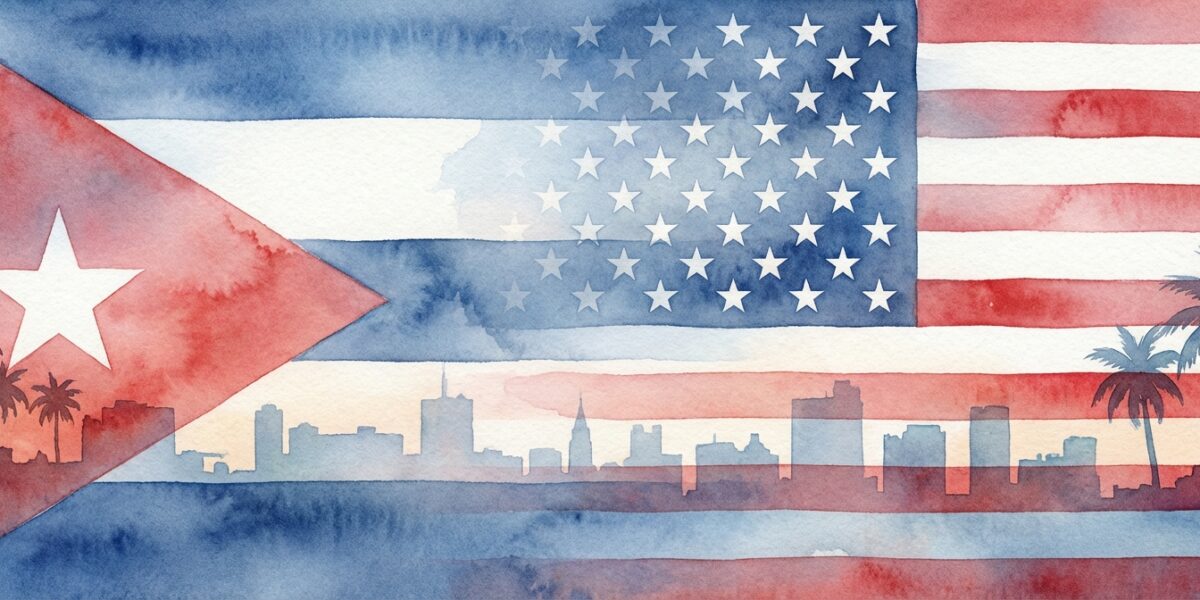
My dad’s side is Cuban. My mom’s side is Nicaraguan. Both of them fled socialism — not because they wanted to, but because the alternative was to submit to a government that tells you how to think, what to say, and whether you’re allowed to eat tonight. They built a life in the United States. I grew up American. But I grew up knowing. Knowing that ninety miles from Florida, there are people who cannot say what I just said without risking prison.
I’ve visited family in Cuba. I’ve seen what socialism actually produces when there’s no America to blame. The hunger isn’t theoretical. The fear isn’t a metaphor. The blackouts aren’t caused by US sanctions — they’re caused by sixty-five years of a regime that invested in political control instead of power plants.
So when someone in a DC think tank tells me we need to “engage” with Havana, that the embargo is the real problem, that if we’d just be nicer to the Díaz-Canel regime things would improve — I don’t just disagree. I find it insulting to every Cuban who’s sitting in a dark room right now, wondering if the Red Berets are coming for them next.
Here’s the truth nobody wants to say clearly: we already know what a free Cuba looks like. And we know exactly what it takes to get there.
What Cubans on the Island Are Actually Saying
Let’s start with the regime’s favorite lie: that ordinary Cubans support the revolution, that the protests are CIA-funded agitators, that the embargo is why people are hungry.
Here’s what the data actually shows. According to a 2024 survey published by Latinoamérica 21:
These aren’t my numbers. These are surveys conducted by independent researchers inside Cuba — people risking their own freedom to ask the questions Havana doesn’t want answered.
On July 11, 2021, tens of thousands of ordinary Cubans did something unprecedented. They took to the streets in over fifty cities chanting “Libertad” and “Patria y Vida.” Not “end the embargo.” Not “more US engagement.” Freedom. From a system in which they have no voice.
American University researcher Michael Bustamante studied those protests. His conclusion: “The protesters this summer were not demanding sanctions relief or an end to the U.S. embargo; they wanted freedom from a political system in which they do not have a voice.”
That’s not a think-tank abstraction. That’s Cuban-on-the-ground reporting.
And Patria y Vida — the song that became the anthem of that uprising — says it plainly: “Se acabó.” It’s over. The Cuban people have decided. The only question is whether United States policy will meet them where they are.
Sixty-Five Years of Excuses — And Every One of Them False
Every time there’s pressure on the regime, Díaz-Canel runs the same playbook: blame America. The “bloqueo.” The “cruellest sanctions in history.” The “financial and energy persecution.”
During the 2024 blackouts — when Cubans endured up to twenty hours a day without electricity — the regime blamed US sanctions. During the current 2026 crisis, with the electrical grid on the verge of total collapse, he’s still reading from the same script.
Here’s what actually happened to Cuba’s power grid: sixty-five years of Communist management destroyed it. The regime spent decades exporting doctors as a revenue stream while the average Cuban can’t access basic medicine. It invested in political prisons and Red Berets instead of infrastructure maintenance. The lights went out because centralized command economies without political accountability don’t work. They never have. They never will.
The regime needs the embargo as an excuse. Every time someone in Washington proposes lifting it without demanding political reform in return, they hand Havana the one thing it wants most: an escape from accountability.
Let me ask the question nobody in the engagement camp can answer: Which US concession, exactly, produced a single lasting political prisoner release? Which sanctions relaxation made the regime more free?
Obama normalized relations — reopened embassies, removed Cuba from the State Sponsors of Terrorism list, loosened travel and trade. The regime pocketed the goodwill and kept arresting journalists. Biden eased sanctions on his way out the door in January 2025, as part of a deal involving prisoner releases. The regime broke its pledge. And when the Cuban government announced 51 prisoner releases in March 2026, experts immediately noted the number was less than the 53 Cuba freed during Obama’s thaw in 2014 — and came with no guarantee they wouldn’t be re-imprisoned at any moment.
Every single time, the pattern is the same: America gives, Havana takes, nothing changes for the Cuban people.
The Blueprint: What a Free Cuba Actually Requires
This is the part that never gets discussed. Everyone has an opinion on the embargo. Almost nobody talks concretely about what the end state should be and how to get there.
Here’s my five-point framework — informed by what Cuban civil society has actually been demanding, what current US policy under Secretary Rubio is pushing for, and what history tells us about transitions from authoritarian regimes.
1. Free Every Political Prisoner — Unconditionally, Immediately
Cuba holds over one thousand political prisoners right now according to Prisoners Defenders. Men and women arrested simply for attending the July 2021 protests. Luis Manuel Otero Alcántara of the San Isidro Movement. Maykel Osorbo of Patria y Vida. Artists, journalists, ordinary people who had the courage to say “Ya no más.”
The Washington Post editorial board wrote last week: “An opening that leaves political prisoners behind will only fund further repression.”
There is no deal. There is no engagement. There is no goodwill until every political prisoner walks free. Not a symbolic 51 chosen by the regime for a photo op. All of them.
This is the non-negotiable first step. Everything else comes after.
2. Open the Internet — Bypass the Regime Entirely
The regime’s stranglehold on information is its oxygen. During the 2021 protests, they shut down mobile data and social media within hours. They did it again during recent protests. The White House’s January 2026 Executive Order explicitly cited the regime’s denial of internet freedom as part of its pattern of human rights violations.
Here’s what unrestricted internet access would mean: satellite-based connectivity, bypassing regime infrastructure entirely, that allows ordinary Cubans to talk to each other, see the outside world, and organize without State Security reading every message.
When information flows freely, the propaganda monopoly that keeps this government alive begins to crack.
The United States should fund this aggressively — not ask Havana for permission, not negotiate for access, just do it.
3. Maintain Economic Pressure Until There Is Real Reform
In January 2026, President Trump signed Executive Order 14380, cutting off Venezuelan oil to Cuba and imposing tariffs on countries that supply oil to the island. Rubio reactivated Title III of the Helms-Burton Act, opening legal pathways for Americans to sue companies handling property confiscated from Cuban families after 1959.
This is the right approach. Not because I want ordinary Cubans to suffer — I don’t. But because the regime feels economic pressure before it feels political pressure, and it will not change without both.
The humanitarian argument for engagement has some validity. People are hungry, sick, and in the dark. But the answer to that is not to hand the regime a lifeline. Send aid. Send internet. Send medicine to NGOs, not government ministries. Just don’t pretend that lifting sanctions without conditions will do anything except extend the regime’s lifespan.
4. Fund Cuban Civil Society — Not the Regime
The San Isidro Movement. The 27N collective. The underground journalists. The human rights monitors. The networks that pass real information inside the island.
These are the Cubans risking prison sentences to speak the truth. They deserve not just moral support from the State Department but material support — communications tools, legal assistance, international platforms, funding.
As AP News reported this week, the Trump administration has already “crippled trade with the island and threatened the future of the Communist Party regime.” The next step is making sure that when the regime weakens, Cuban civil society — not another strongman — fills the vacuum.
5. Plan for the Day After
Here’s what nobody in Washington is seriously discussing: what happens when the regime falls?
Given the current trajectory — daily protests since March 6, a collapsing grid, an oil blockade, a regime more isolated than at any point since the Soviet collapse — that day may come sooner than anyone expected. And there is currently no operational framework for what comes next.
A free Cuba needs:
Eastern Europe in 1989 teaches us something: regimes don’t fall from external pressure alone. They fall when economic pressure, internal civil society movements, information flow, and a credible post-regime framework converge.
Cuba 2026: economic pressure ✅, internal protests ✅, information access ⚠️, post-regime framework ❌
We’re three-quarters of the way there. We should build the fourth piece before the crisis overtakes us.
This Is Personal — And That’s Why It Matters
I write this as someone whose family story is woven into this history.
My dad is Cuban. My mom is Nicaraguan. Both sides of my family fled socialism for the United States. I didn’t grow up hearing romantic stories about the homeland — I grew up hearing about the fear, the scarcity, the knock on the door in the middle of the night.
I’ve been to Cuba. I’ve seen family members ration food. I’ve seen the buildings that haven’t been painted since Batista left. I’ve seen the young men on the Malecón at sunset, staring at ninety miles of water that might as well be a thousand.
I am tired of this being treated as an abstract foreign policy debate by people who have never set foot in a country where you can be arrested for saying the wrong thing out loud.
Cuba is not a thought experiment. It is a country of eleven million human beings who deserve the same freedom you and I take for granted.
The pressure is building. The protests are growing. The regime is more isolated than it has been in a generation. The electricity is out and the people are in the streets and the Red Berets can’t be everywhere at once.
Freedom for Cuba isn’t a fantasy. It’s a policy. And we know exactly what it takes.
Stay the course. No premature deals. No sanctions relief for empty promises. No lending this regime the credibility it needs to survive another decade.
Patria y Vida.