

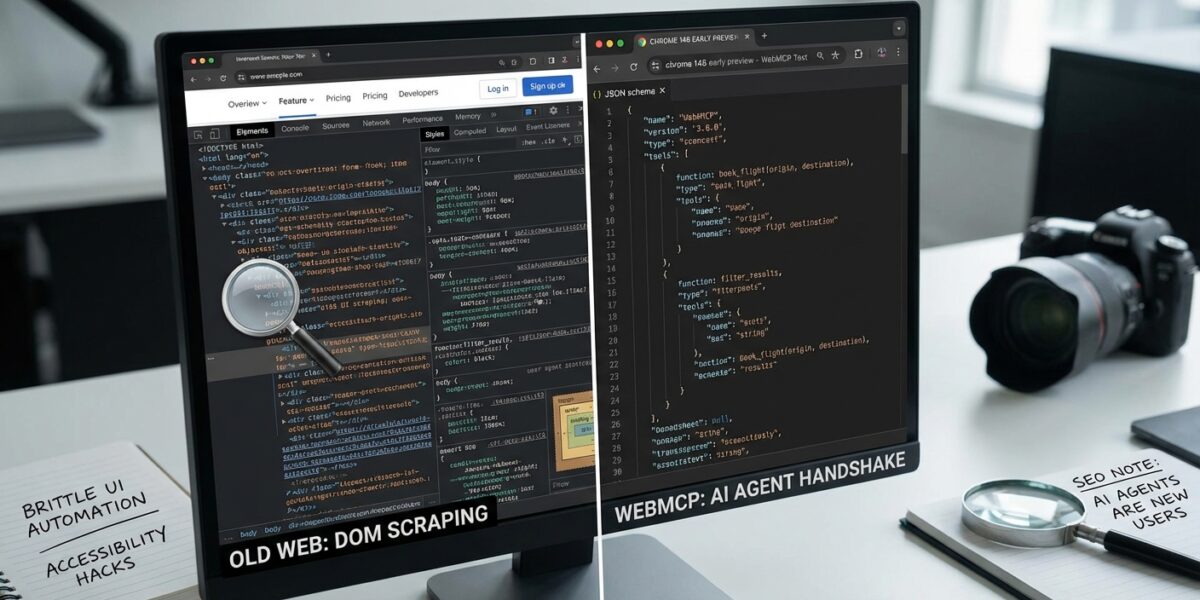
WebMCP just landed in Chrome’s latest update, introducing a new standard that fundamentally changes how AI agents interact with websites. If you’re in marketing or SEO, you need to understand what this means for your digital strategy.
I’ve been watching the AI agent space closely for the past year, and this feels like one of those pivotal moments. WebMCP isn’t just another browser feature—it’s a complete paradigm shift in how websites communicate with artificial intelligence.
What Exactly Is WebMCP?
WebMCP (Web Model Context Protocol) is a new web standard that landed in Chrome 146 in February 2026. According to bug0.com, this new protocol allows websites to register structured tools for AI agents without requiring screen-scraping or separate MCP servers.
Before WebMCP, AI agents had to interact with websites the hard way—by looking at screenshots, parsing HTML, and essentially guessing which buttons to click. It was like trying to operate a smartphone while blindfolded.
Now, with WebMCP, websites can register structured “tools” that AI agents can discover and use directly. Instead of an AI agent scraping your DOM to find a search form, your site can simply tell the agent: “I have a search tool. Give me a query, and I’ll return structured results.”
The Technical Foundation That Actually Matters
Here’s what makes this interesting from a practical standpoint. WebMCP is built on JSON Schema, which is already the standard that Claude, GPT, and Gemini use for tool-calling. This isn’t some proprietary Google thing—it’s a W3C standard co-authored by engineers at both Microsoft and Google, as detailed in the official WebMCP specification.
The API lives at navigator.modelContext, and developers can register tools with natural language descriptions and structured inputs. Like most powerful browser APIs, it requires HTTPS (though localhost gets a pass during development).
What caught my attention is the performance data. Research shows WebMCP reduces AI processing requirements by 67.6% while maintaining nearly identical task success rates. That‘s not just efficiency—that‘s a fundamental improvement in how AI agents work.
Two Approaches for Different Use Cases
WebMCP offers two implementation paths:
- Declarative API: For standard actions that can be defined directly in HTML forms
- Imperative API: For complex, dynamic interactions requiring JavaScript execution
This flexibility means everything from simple contact forms to complex e-commerce workflows can be made AI-agent friendly.
Why This Matters for SEO and Marketing
I’ve been doing SEO for over 20 years, and I can tell you that major shifts like this don’t happen often. But when they do, the businesses that adapt early get a significant advantage.
Think about it this way: we’ve spent decades optimizing for search engines. Now we need to start thinking about optimizing for AI agents that might never see your traditional UI.
The End of Screen-Scraping Chaos
Right now, AI agents interacting with websites is frankly a mess. They’re trying to figure out your site by looking at screenshots and parsing HTML. Every time you redesign, change a button label, or rearrange your layout, agents have to relearn everything.
I’ve been testing how AI marketing agents handle web forms lately, and honestly, it’s been frustrating. WebMCP could solve this by giving agents a stable, structured way to interact with your site regardless of design changes.
New Opportunities for User Experience
Here’s where it gets interesting for marketers. WebMCP isn’t just about making existing interactions better—it opens up entirely new possibilities. Imagine an AI agent that can:
- Generate personalized product recommendations by calling your recommendation API
- Check real-time inventory without scraping your product pages
- Process complex quote requests through structured forms
- Access customer-specific pricing or availability data
This is particularly relevant if you’re already working with automated marketing systems. WebMCP could be the bridge that makes these interactions seamless.
What You Should Do Right Now
WebMCP is still in early preview, hidden behind Chrome’s “Experimental Web Platform Features” flag. But given that both Google and Microsoft are backing this standard, it’s likely to ship widely soon. As noted by dev.to, this represents the end of AI agents clicking buttons and the beginning of structured web interactions.
Start Planning Your Implementation
Begin by auditing your most important user flows. Which actions do users take on your site that could benefit from structured AI interaction? Common candidates include:
- Search and filtering functionality
- Lead capture forms
- Product configuration tools
- Appointment booking systems
- Quote request processes
Document these flows and start thinking about how they could be exposed as WebMCP tools.
Consider the SEO Implications
This ties into broader changes we’re seeing in search. Google’s recent core updates have emphasized the importance of structured data and clear content organization. WebMCP feels like the next evolution of that trend.
Start thinking about how AI agents might discover and interact with your content. The same principles that make for good schema markup will likely apply to WebMCP tool definitions.