
A review generation strategy is the systematic process of consistently asking, collecting, and responding to customer reviews across platforms — primarily Google — in a way that builds your online reputation without requiring manual effort every single day. If you’re a local business owner and you’re still relying on the occasional happy customer to leave a review on their own, you’re leaving serious ranking power on the table.
I’ve spent over 20 years doing SEO, and I can tell you that nothing has shifted the local search game more dramatically in the past two years than how Google now uses reviews. We’re not talking about a vanity metric anymore. Reviews are a ranking input, a trust signal, and increasingly, a data source for AI-powered search results. If you want to know how to get more Google reviews in a way that actually moves the needle for local SEO, you need a system — not a one-time push.
Let me walk you through how to build a system that generates reviews consistently — one that doesn’t depend on you remembering to ask every customer manually.
Why Google Reviews Matter More Than Ever for Local SEO in 2026
Google currently holds about 81% of the online review market share, up from 79% in 2023, according to the 2025 Review Dingo industry report. That dominance isn’t slowing down. And the stakes are higher than just star ratings. For local SEO, reviews have become one of the most direct levers you can pull to improve your visibility in the local pack.
Google’s local algorithm uses reviews to assess three things: recency, sentiment, and velocity. Recency means how recently you got a review. Sentiment is the emotional tone and specific keywords in the review text. Velocity is the rate at which reviews come in over time.
That last one is where most businesses fail. They’ll run a push campaign, get 15 reviews in a week, then go dark for three months. Google’s AI moderation systems are sophisticated enough to flag unnatural spikes. In fact, Google removed reviews from over 60,000 businesses in 2026 alone, targeting suspicious patterns particularly in home services industries.
"Google reviews are no longer just a trust signal — they’re a ranking factor, conversion driver, and AI data source."
— Anya Vitko, Vendasta
Steady, consistent review flow is what the local SEO algorithm rewards. That’s exactly what an automated review generation strategy delivers.
For more context on how Google’s local ecosystem works, check out my Google My Business complete optimization guide — it covers the full picture of what’s influencing your local pack rankings right now.
The Trust Factor: How Online Reputation Drives Real Buying Decisions
Here’s something that still surprises people when I bring it up: according to a 2024 survey cited by Alchemer’s 2025 consumer trust guide, 95% of customers say they trust businesses more when they have a higher volume of reviews. And by 2025, 54% of consumers said they trusted online reviews more than recommendations from family, marketing messages, or influencer content.
That’s not a small shift. That’s a fundamental change in how people make buying decisions. Your online reputation — built largely through Google reviews — is now your most credible sales asset. For local businesses especially, a strong review profile is often the deciding factor between a phone call and a scroll past.
The good news is that perceptions of fake reviews are actually improving. The percentage of consumers who suspected Google reviews were fake dropped from 50% in 2023 to 40% in 2025. Authentic, steady review generation is working. People are starting to trust the system again — which means your online reputation has never been more valuable or more believable.
The Anatomy of an Autopilot Review Generation System
Let me break down exactly what a well-built review generation system looks like. This isn’t theory — I’ve implemented versions of this for service businesses across Central Florida and beyond. Each component is designed to help you get more Google reviews without adding work to your plate.
Step 1: Trigger-Based Request Timing
The single biggest mistake I see in any review generation strategy is asking for reviews at the wrong time. Asking before the job is done, or three weeks after, both kill your conversion rate.
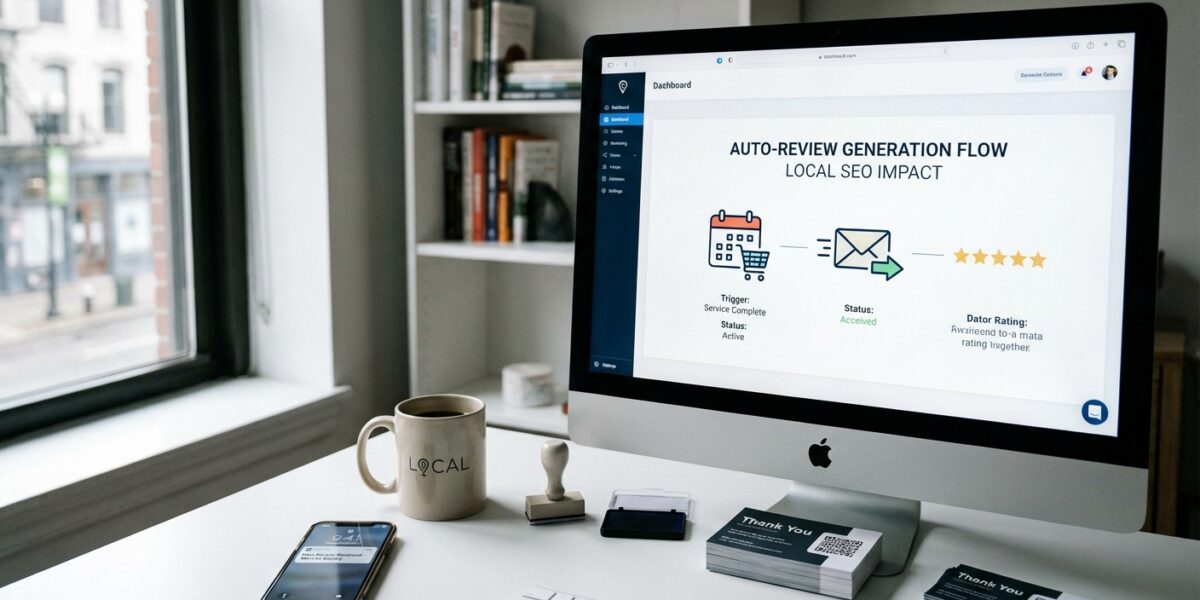
The sweet spot is 24 to 48 hours after service completion. That’s when the experience is fresh, the customer is satisfied, and they haven’t yet moved on mentally. Your CRM or field service software should be able to trigger an automated message at this exact window.
If you’re using something like Jobber, Housecall Pro, or ServiceTitan, this trigger capability is built in. If you’re on a simpler CRM, Zapier can connect the dots between a job marked "complete" and a review request going out automatically.
Step 2: Email First, SMS as Backup
SMS used to be the go-to channel for review requests. But SMS click-through rates for review requests dropped from 8% in 2023 to 6% in 2024, largely because consumers are drowning in spam texts. The FCC reported 19.2 billion spam texts in February 2025 alone.
Email is your primary channel now for any serious review generation strategy. It gives you more room to personalize, it’s less intrusive, and it converts better at scale. Use SMS as a follow-up only — not your first touch.
Your email should be short, personal in tone, and include a direct link to your Google review form. Don’t make people search for where to leave the review. Every extra click is a drop-off point. Generate your direct review link through your Google Business Profile dashboard and hardcode it into your template. This one step alone can significantly increase how many Google reviews you actually collect.
Step 3: One Follow-Up, Not Three
A single follow-up email, sent about five days after the first, can add roughly 50% more reviews to your total. I’ve seen this play out consistently across multiple client accounts.
But don’t be that business that sends three or four follow-ups. One reminder is helpful. Two starts to feel pushy. Three and you’re damaging the relationship you just built — and potentially your online reputation along with it.
Step 4: Personalization Matters More Than Automation Efficiency
Here’s where a lot of businesses go wrong with automation: they optimize for efficiency and lose the human touch entirely. Generic