

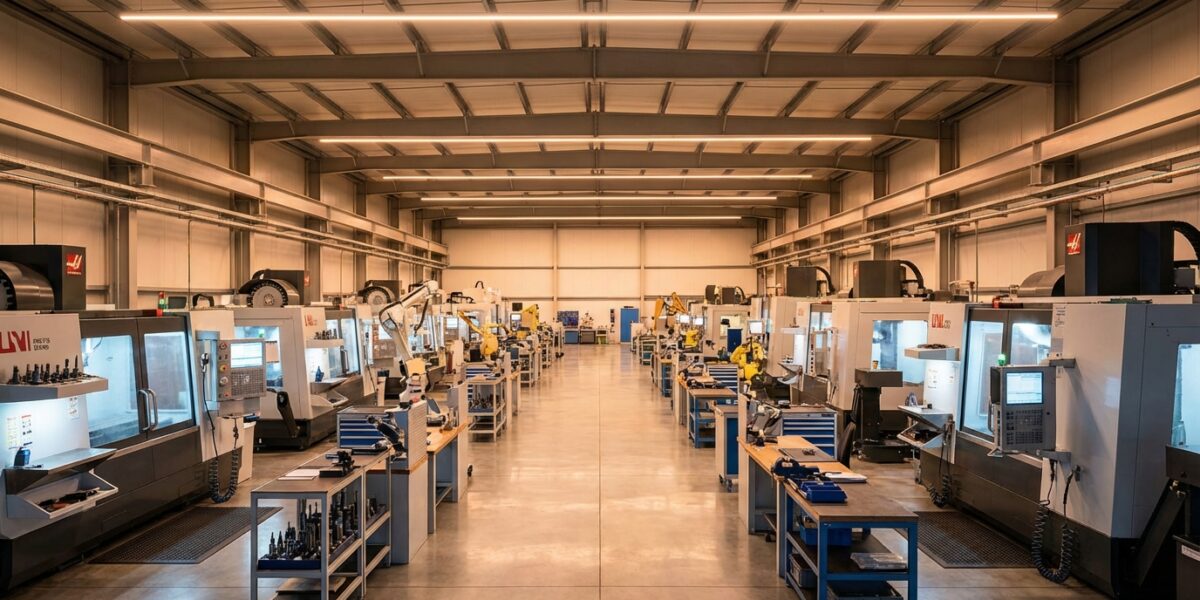
Digital marketing for manufacturers is still one of the most underserved conversations in the industry. You’ve got billion-dollar factory floors, complex supply chains, and engineering teams that could land a rover on Mars —. But the website looks like it was built during the Bush administration and the only lead gen strategy is “call your distributor.” I’ve worked with enough industrial and B2B clients over the past two decades to know that this gap is real, and it’s costing companies serious revenue.
The good news? The manufacturers who are investing in digital right now are pulling ahead fast. And the barrier to entry is lower than most operations managers think.
Why Industrial Marketing Is Different (And Why That Matters)
Industrial marketing — sometimes called B2B industrial marketing — refers to the strategies manufacturers, distributors, and industrial service providers use to reach buying teams, engineers, plant managers, and other technical decision-makers. It’s not the same as B2C marketing. The sales cycles are longer, the buying committees are larger, and the content needs to be technically credible.
According to a 2022 IndustrialSage survey, 98% of industrial manufacturers generate sales-qualified leads through digital marketing. That number surprised me when I first saw it, but after thinking about it — it makes sense. Even the most old-school buying manager Googles your company before picking up the phone.
And yet, only 30% of manufacturing companies use marketing automation, according to data cited by Salesmate. That’s a massive gap between what’s possible and what’s actually being done.
The Channels That Actually Work for Manufacturers
Let me give you the honest breakdown, not the generic “be on every platform” advice you’d get from a generalist agency.
Organic Search (SEO) — Your Highest-ROI Channel
The same 2022 IndustrialSage survey found that 69% of industrial manufacturers use organic search as a lead channel. In my experience working with B2B clients in manufacturing and industrial services, SEO consistently delivers the best cost-per-lead over time. It’s not fast, but it compounds.
The key for manufacturers is technical and spec-driven content. Engineers and buying managers search for things like “ASTM A36 steel plate supplier Florida” or “ISO 9001 certified CNC machining shop.” They’re not searching “best metal company.” Your content strategy needs to match how your actual buyers search, not how your sales team describes your products internally.
I wrote a deeper breakdown of where search is heading in my post on SEO in 2026: What Will Stay the Same (And What You Can Ignore) — a lot of it applies directly to industrial buyers.
LinkedIn — The B2B Industrial Social Channel
According to the Content Marketing Institute, 93% of B2B marketers rate LinkedIn as the most effective social channel. That tracks with what I see in client campaigns. For manufacturers, LinkedIn works best for:
- Targeting plant managers, engineers, and buying directors by job title and industry
- Thought leadership content from company executives or engineers
- Account-based marketing (ABM) campaigns targeting specific companies
- Promoting case studies and technical whitepapers
Facebook ads still have a role — the same IndustrialSage data shows 76% of B2B marketers use Facebook ads —. But for most industrial companies, LinkedIn is where I’d put the majority of paid social budget.
PPC — Fast Pipeline, But Watch Your Targeting
43% of industrial manufacturers use PPC as part of their channel mix. Done right, Google Ads can generate qualified leads quickly while your SEO builds. Done wrong, you’ll burn through budget on irrelevant clicks from job seekers and students.
I ran a six-month deep dive on exactly this topic — how industrial buyers actually search when they’re in buying mode. If you’re running or considering Google Ads for a manufacturing business, read my post What 6 Months of B2B Google Ads Revealed About How Industrial Buyers Actually Search before you spend a dollar.
Your Website Is a Sales Asset, Not a Brochure
This is the part where I get a little direct: if your website is slow, hard to navigate on mobile, or buried under 15 clicks of navigation to find a product spec sheet — you are losing deals you don’t even know you’re losing.
According to research from Lform Design, 40% of industrial buyers base buying decisions on website quality. That’s not about looking pretty. It’s about whether your site communicates credibility, makes specs easy to find, and gives buyers a clear next step.
The IndustrialSage data puts average website visitor-to-lead conversion at 5–8%, with visitor-to-customer at around 4.6%. If your site is converting below that range, the problem is usually one of three things: slow page speed, poor content structure, or a weak or missing call-to-action.
Google’s Core Web Vitals — which measure load speed, interactivity, and visual stability — are a real ranking factor. A manufacturer with a fast, well-structured site has a legitimate competitive advantage in search right now because so many industrial sites are still running on legacy platforms.
Content Strategy for Technical Buyers
Here’s the angle I don’t see talked about enough in manufacturing marketing circles: your engineers are your best content creators, and most companies never use them.
A 500-word FAQ written by your lead engineer about how your tolerances compare to industry standard — that’s the kind of content that ranks, builds trust, and shortens the sales cycle. It answers the exact questions a buying manager would ask before calling you. It shows expertise that no generic agency copywriter can fake.
The 2022 IndustrialSage data shows video is increasingly dominant in industrial content — 60% short-form, 38% long-form. A plant walkthrough video, a product demonstration, or a “how it’s made” clip doesn’t need to be Hollywood-produced. It needs to be accurate and informative.
76% of manufacturers are now using generative AI tools, per IndustrialSage. I’m not against using AI to help draft content — I use it myself. But in a space where technical accuracy is everything, you need a subject matter expert reviewing every piece before it goes live. AI can help you scale; it can’t replace the engineer who knows the difference between your process and a competitor’s.
“Industrial buying moved online, and it’s not coming back. Manufacturers investing in analytics, UX, SEO, and content are pulling ahead.”
— Lform Design, 2026 Digital Marketing Analysis for Manufacturers
The Budget Reality for Manufacturing Marketing
One of the most common objections I hear from manufacturing executives is that marketing feels like an expense, not an investment. That mindset is changing — slowly — but it’s still a real barrier.
Gartner’s CMO Spend Survey data shows marketing budgets averaged 6.7% of revenue in 2024, with a projected increase to 9.5% in 2025. For manufacturers exactly, I usually see budgets in the 5–7% of revenue range being the most competitive benchmark for companies trying to grow digitally.
What I tell clients: you don’t need to do everything at once. Start with three things — a fast, credible website, a consistent SEO content strategy, and a LinkedIn presence. Those three alone, executed well, will outperform most of your competitors who are still relying on trade shows and referrals.
Speaking of trade shows — the IndustrialSage data puts trade shows at only 16% effectiveness for lead gen, behind email (18%) and social/online ads (14%). Trade shows aren’t dead, but they shouldn’t be carrying your entire pipeline.
Marketing Automation and CRM: The Infrastructure Gap
Here’s the stat that keeps me up at night for manufacturing clients: only 30% of manufacturing companies use marketing automation. Yet 84% of marketers who do use automation report achieving their top marketing goals. That gap is a massive opportunity for any manufacturer willing to invest in the infrastructure.
At minimum, you need a CRM that connects to your website and tracks where leads come from. Without that, you’re flying blind on what’s actually working. Attribution — knowing which channel influenced a deal — is how you justify and optimize your marketing budget over time.
I covered the broader landscape of where automation is heading in my post on Marketing Automation Trends 2026: AI, Privacy, and Personalization at Scale. The principles apply directly to industrial companies building their first real marketing stack.
“Focus on programs that influence active deals and show contribution to pipeline and revenue.”
— Act-On Software, B2B Marketing Automation Best Practices
Account-Based Marketing (ABM) for Industrial Companies
If you have a defined list of target accounts — say, the 50 OEMs you most want as customers — ABM is worth serious consideration. ABM means tailoring your marketing to specific companies and buying groups rather than casting a wide net.
For manufacturers with long sales cycles and high deal values, this approach makes a lot of sense. You can use LinkedIn’s targeting to serve content exactly to employees at your target accounts, coordinate with your sales team on outreach timing, and measure engagement at the account level rather than just counting leads.
Gartner has noted that by 2025, 80% of B2B sales interactions occur in digital channels, and buyers expect a more personalized, self-serve experience. ABM is one of the best ways to deliver that at scale without losing the human touch that complex industrial sales need.
FAQ: Digital Marketing for Manufacturers
What digital marketing channels work best for industrial manufacturers?
Based on IndustrialSage’s 2022 survey data, organic search and social media (each at 69%) are the most widely used channels, followed by PPC at 43%. Email marketing has the highest reported effectiveness at 18%. For most manufacturers, I’d prioritize SEO, LinkedIn, and email before expanding to other channels.
How much should a manufacturing company spend on digital marketing?
Gartner’s data puts the 2024 average at 6.7% of revenue, with projections toward 9.5% in 2025. For manufacturers just starting to invest in digital, 5% of revenue is a reasonable starting benchmark. The key is tracking ROI from day one so you can justify increasing the budget as results come in.
Is SEO worth it for a B2B industrial company?
Yes — consistently. The sales cycles in industrial B2B are long, which means buyers do extensive research before contacting a vendor. Ranking for the specific technical terms your buyers search gives you visibility at the exact moment they’re evaluating options. It takes 6–12 months to see significant results, but the cost-per-lead over time is usually lower than paid channels.
Do manufacturers need to be on social media?
LinkedIn, yes. Other platforms depend on your audience. If you’re selling to plant managers and engineers, LinkedIn is where they are professionally. Facebook can work for brand awareness and retargeting. TikTok and Instagram can be effective for recruitment and brand building, but I wouldn’t prioritize them for lead generation unless you have the resources to do them well.
Resources
- IndustrialSage Industrial Marketing Trends Report — Annual survey data on channel effectiveness and lead generation for manufacturers
- Content Marketing Institute B2B Research — Annual benchmarks for B2B content marketing including social channel effectiveness
- Gartner CMO Spend Survey — Annual data on marketing budget benchmarks across industries
- Thomasnet Industrial Marketing Insights — Research and guides specifically for industrial and manufacturing marketers
- Search Engine Land B2B SEO Guide — Practical SEO guidance for B2B and industrial content strategies
TL;DR
- Definition: Digital marketing for manufacturers refers to online strategies — SEO, PPC, social media, email, and content — used to reach technical buyers like engineers, buying managers, and plant directors.
- Lead generation: 98% of industrial manufacturers generate sales-qualified leads through digital marketing, according to a 2022 IndustrialSage survey.
- Top channels: Organic search and social media are each used by 69% of industrial manufacturers; email marketing has the highest reported effectiveness at 18%.
- LinkedIn dominance: 93% of B2B marketers rate LinkedIn as the most effective social channel for reaching professional and technical buyers, per the Content Marketing Institute.
- Website impact: 40% of industrial buyers factor website quality into buying decisions; average visitor-to-lead conversion for industrial sites is 5–8%.
- Automation gap: Only 30% of manufacturing companies use marketing automation, despite 84% of marketers who use it reporting they achieve their top goals.
- Budget benchmark: Gartner data puts average marketing spend at 6.7% of revenue in 2024; 5–7% of revenue is a reasonable starting benchmark for manufacturers investing in digital.
- Content priority: Spec-driven, technically accurate content — ideally created or reviewed by engineers — is the highest-trust content type for industrial buyers and performs well in search.