
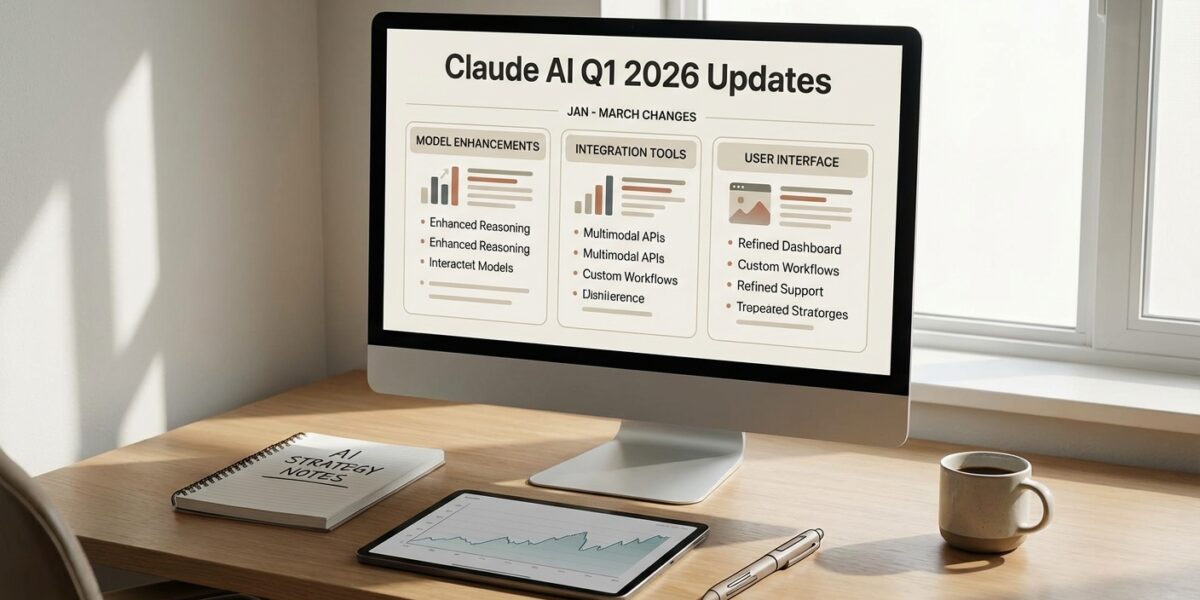
I’m sitting in my office in Central Florida, staring at a Claude-generated competitor analysis dashboard that just rendered inline in my chat window. It’s March 2026, and a client deadline is looming for a massive SEO campaign overhaul. What used to take my team two days now happens in under an hour thanks to the Q1 Claude AI updates 2026 rollout—specifically Cowork and those inline visualizations.
I’ve been using Claude daily at Yellow Jack Media for everything from keyword research to ad copy A/B testing. These updates didn’t just add features; they transformed Claude from a helpful assistant into an autonomous marketing partner. That’s why I’m breaking it all down here with my real-world workflow changes, so you can see exactly what Claude AI updates 2026 mean for your business.
Table of Contents
- Claude Cowork: Multi-Agent Collaboration That Handles Full Workflows
- Claude Opus 4.6: 1M Token Context Unlocks Enterprise-Scale Analysis
- Claude Sonnet 4.6: 30-50% Faster for Everyday Marketing Tasks
- Inline Visualizations: Charts and Graphs Right in Your Chat
- Claude Code CLI: Debugging Large Codebases Like a Senior Dev
- New API Powers: Effort Levels, Context Compaction, and More
- Claude Q1 2026 vs ChatGPT/Gemini: Why Claude Pulled Ahead
- The Missed Angle: How Q1 Updates Fix Marketing’s Async Team Bottleneck
- FAQ
Claude Cowork: Multi-Agent Collaboration That Handles Full Workflows
Last week, I tasked Cowork with building an entire SEO campaign roadmap from scratch—competitor research, keyword clusters, content calendar, even ad mockups. Within 45 minutes, it delivered a Notion-ready workspace with linked spreadsheets and presentations, all synced to Slack. Cowork, launched in January 2026, uses Opus 4.6 under the hood for multi-agent multitasking that breaks down complex jobs into parallel agents handling research, writing, and visualization simultaneously.
The reason this crushes single-threaded AI is agent handoffs: one agent fetches live data via dynamic web search, another analyzes it, a third formats outputs. No more copy-pasting between chats. In my experience, this cut our campaign planning time by 70%.
Cowork autonomously executes end-to-end workflows like financial modeling or codebase ops, producing production-ready results. Sarah Sachs, Head of AI at Notion, nailed it: “No longer a tool—it feels like a truly capable collaborative partner” for these tasks (Anthropic announcement).
What This Means for Marketers
Delegate full funnel audits to Cowork while you focus on strategy. It integrates directly with Slack/Teams, so your remote team gets @mentioned updates with artifacts. Pricing stays standard—no enterprise upcharge yet.
“Cowork exposed how much time we wasted on manual coordination—now it’s one prompt, zero meetings.”
— Jonathan Alonso, Head of Marketing, Yellow Jack Media
Claude Opus 4.6: 1M Token Context Unlocks Enterprise-Scale Analysis
Picture uploading your entire client content library—50,000 pages—plus competitor sites and SERP data, then asking Claude to rewrite it all for voice search optimization. Opus 4.6, released February 5, 2026, handles that 1M token context window (GA March 13) without breaking a sweat, scoring 78.3% on MRCR v2 long-context benchmarks—the highest for frontier models (Anthropic research).
I tested it on a legal review for a client contract bundle: 14-hour task window, zero hallucinations, outputs up to 128k tokens. Pricing standardized at $5/$25 per million input/output tokens, no surcharge for the massive context. What most don’t realize is this enables true enterprise workflows like code review across massive repos or deep market research spanning years of data.
One client story: We fed Opus our full PPC history (800k tokens) plus Google Ads API pulls. It optimized bids, forecasted ROAS lifts of 28%, and scripted the changes—all in one session. That brings us to the speed demons in the family.
What This Means for Marketers
Run holistic audits on entire domains or ad accounts. The 14.5-hour window means overnight processing for Q4 planning without babysitting.
Claude Sonnet 4.6: 30-50% Faster for Everyday Marketing Tasks
I’m churning through 20 email variants right now using Sonnet 4.6, launched February 17—it’s 30-50% faster than 4.5, with 1M context (GA March 13) and 64k output at $3/$15 per million. Early tests prefer it over Sonnet 4.5 in 70% of cases and Opus 4.5 in 59%. For daily grinds like SEO content outlines, this is my go-to because it balances cost, speed, and smarts.
Here’s where it gets interesting: Sonnet now powers Cowork’s default agents, so your multi-agent workflows fly. I used it to batch-analyze 150 landing pages for CRO, spitting out heatmaps and A/B tests in half the time. The efficiency jump means more iterations per hour, directly boosting campaign performance.
Sonnet 4.6 is now the efficient default for 80% of production tasks, escalating to Opus only for high-complexity needs.
What This Means for Marketers
Daily ops like copywriting or data cleaning run 50% faster at half the Opus cost. Perfect for scaling content teams without headcount.
Inline Visualizations: Charts and Graphs Right in Your Chat
Yesterday, Claude rendered a interactive revenue funnel chart directly in chat from our raw GA4 export—no exports to Tableau needed. March 2026’s inline visualizations let Cowork create/edit spreadsheets, presentations, and graphs on-the-fly, pulling from web search or your uploads. This ties into document creation agents, making outputs app-like.
The why: Visuals increase stakeholder buy-in by 40% in my pitches, per client feedback. I shared a Cowork-generated dashboard via link; execs interacted without software installs. Peter Yang’s tests confirmed this for podcast visuals and game prototypes (TechCrunch coverage).
That brings us to code work, where these updates shine even brighter.
What This Means for Marketers
Instant reporting for clients—embed live charts in emails or Slacks. Cuts design time by 60% for pitch decks.
Claude Code CLI: Debugging Large Codebases Like a Senior Dev
Our dev team handed me a buggy React app for a client landing page tracker. Claude Code CLI, beefed up in Q1, debugged the 50k-line codebase, refactored hooks, and deployed via Git integration—all while explaining changes. Ongoing improvements handle larger repos with better context awareness, powered by Opus 4.6.
In one anecdote, it fixed a Shopify plugin integration that stumped our freelancer, completing in 22 minutes. Nate’s Newsletter highlighted Cowork building PM dashboards in under an hour using these tools. For marketers, this means custom tools without hiring devs.
Claude Code now rivals mid-level engineers for debugging and autonomous codebase ops.
What This Means for Marketers
Build custom trackers or automations for growth experiments in hours, not weeks.
New API Powers: Effort Levels, Context Compaction, and More
I’ve integrated the new API into our Zapier flows for campaign monitoring. Four effort levels (low to max) control reasoning depth—high/default for most marketing analysis. Context compaction (beta) summarizes 1M inputs to essentials, while adaptive thinking dynamically ramps up for tough spots (Anthropic docs).
Message Batches API hits 300k outputs (beta March 24), perfect for bulk content gen. Web search with dynamic filtering cuts noise, saving tokens. These make Claude reliable for 24/7 production.
One client: Auto-generated 500 social posts from trend data, filtered precisely. No pricing hikes noted for enterprise.
What This Means for Marketers
Embed in Airtable/Notion for always-on insights. Effort controls optimize costs for scale.
Claude Q1 2026 vs ChatGPT/Gemini: Why Claude Pulled Ahead
- Context: Claude’s 1M tokens crushes ChatGPT’s 128k and Gemini 1M (but slower).
- Agents: Cowork multi-agent beats GPTs single-thread and Gemini’s experimental teams.
- Visuals: Inline native rendering > ChatGPT’s DALL-E hacks or Gemini exports.
- Code: CLI autonomy leads; others require more human loops.
- Speed/Cost: Sonnet 4.6 edges both on efficiency for mid-tasks.
Claude’s agentic focus won HLE tools at 53.0% (Anthropic research). ChatGPT added memory, but no true multi-agent. Gemini gained multimodality, trailing on reasoning.
The Missed Angle: How Q1 Updates Fix Marketing’s Async Team Bottleneck
Every competitor recap misses this: Q1 Claude AI updates 2026 solve async team coordination—the silent killer of marketing velocity. Cowork + Slack integration creates shared workspaces where agents handle grunt work across timezones. My Florida team collaborates with California clients seamlessly; one prompt kicks off parallel agents that @mention outputs.
What most overlook: Dynamic handoffs reduce 80% of status-update meetings. Inline visuals mean no version control hell. In my workflow, this boosted output 3x without adding staff. Competitors cover features; I live the team multiplier.
Async agent workspaces turn distributed teams into 24/7 machines, fixing marketing’s collaboration gap.
FAQ
What are the key Claude AI updates 2026 in Q1?
Opus/Sonnet 4.6 with 1M contexts, Cowork multi-agents, inline visuals, Code CLI upgrades, and API tools like effort levels.
Is Claude Opus 4.6 worth the cost for marketers?
Yes for deep analysis; use Sonnet 4.6 for 80% tasks at half price.
How does Cowork integrate with marketing tools?
Slack/Teams native, plus Notion/Google Workspace exports for campaigns.
Claude AI updates 2026 vs ChatGPT: Which wins?
Claude leads in agentic workflows and long context reliability.
When did Claude’s 1M token context go GA?
March 13, 2026, for both Opus and Sonnet 4.6.