

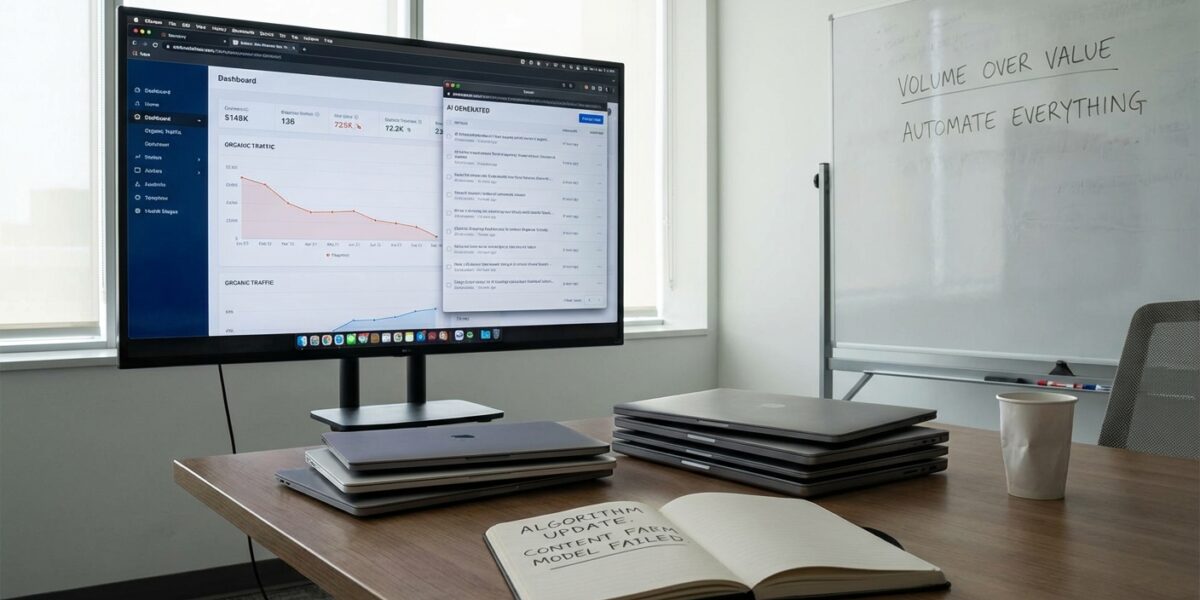
March 2024 traffic graphs looked like Niagara Falls. Sites that hit “publish” on 1,000 raw ChatGPT slugs lost 90 % of clicks overnight, while competitors who polished 50–100 hybrid pieces jumped 80 %. Same starting line, opposite finish. Below is the autopsy—and the cheat sheet—to keep your site off the casualty list.
Google never hated AI; it hates empty bulk. The 2023 (and still-screaming 2026) core update says: “We care if it’s good, not who—or what—wrote it.” The algorithm can’t detect robot prose, but it can measure thin user value:
- Time-on-site under 15 sec
- Pogo-sticking back to SERP
- Zero-click exits
- Ad-clicks that don’t convert
- No corroborating sources or author credentials
Ahrefs audited 600 k pages: correlation between “% of AI text” and ranking was 0.011—noise. The killer signal: thin value.
Anatomy of an AI Content Farm Google Penalty
1. Scaled Content Abuse – 1,200 near-identical “Best Divorce Lawyer in [City]” pages, zero data, quotes, or case studies. 2. E-E-A-T Vacuum – No author bio, no legal credentials, no outbound links to bar-association data. 3. Ad-First Layout – 728×90 above the fold, sidebar units every 200 px, 17 words visible before scroll. 4. Manual Action Trigger – One spam report can flag the entire pattern.
Penalty timetable:
- Algorithmic demotion: 2–6 mo. recovery
- Manual action: 3–6 mo. after reconsideration request
- Complete de-index: 6–24 mo. (death sentence for most businesses)
The 50-Article Sites That Escaped the Google AI Content Crackdown
Niche players using a hybrid workflow:
- AI first draft (1,200 words)
- Proprietary data—surveys, product screenshots, pricing tables
- Expert quotes (founder, PhD, head of support)
- 2–3 posts/week, not 50/day
- Internal links to existing pillar pages
Result: +30 % to +80 % organic traffic within two update cycles, plus featured snippets on mid-funnel queries.
4-Step AI Workflow That Passes 2026 Quality Gates
1. Prompt for Depth, Not Width
“Write a 2,000-word induction vs. gas cooktop guide for restaurant owners. Include lifecycle-cost table, 2026 health-code citations, three chef quotes.”
2. Human Layer
Fact-check stats, insert 2026 DOE energy ratings, swap generic quotes for real interviews.
3. E-E-A-T Layer
Author page with LinkedIn, certifications, peer-reviewed citations.
4. Tech Hygiene
Pass Core Web Vitals, add Product & FAQ schema, TOC jump links.
Red-Flag Checklist: Avoid These to Dodge the Google AI Content Crackdown
✗ 1,000+ pages published in 30 days
✗ No internal links older than 90 days
✗ AI images with default DALL-E watermark
✗ Duplicate H1 and title tag
✗ 100 % affiliate outbound links, zero .edu/.gov references
New KPI: Helpfulness per Published Unit
Ask before you hit publish:
- Does this page answer the query better than the current top-three URLs?
- Would I email it to a paying client?
- Could a journalist cite it without an hour of fact-checking?
If the honest answer is “maybe not,” keep it in draft.
Tool Stack Used by Penalty-Proof Teams
- Perplexity – real-time source hunting
- Claude – long-form structure
- Originality.ai – overlap detection (not AI detection)
- Search Console beta “Helpfulness Report” – flags high-bounce + low-scroll pages
Bottom line: Google’s 2026 updates are a quality heat-seeker, not an anti-AI missile. Publish 50 helpful, edited, source-rich articles and you’ll outrank 1,000 pages of AI slop every time. The apocalypse only hit farms that confused velocity with value.