

If you’ve been in SEO long enough, you’ve watched the same cycle repeat itself: a major algorithm shift hits, panic spreads across Twitter (now X), agencies rebrand their service pages overnight, and suddenly everyone’s selling you the “new” way to rank. I’ve been doing this since before Google had a blog. And I’ll tell you what I tell every client who calls me nervous about the latest update — SEO fundamentals 2026 look a lot more like SEO fundamentals 2016 than most people want to admit. The platforms change. The delivery mechanisms change. The core principles? Not so much.
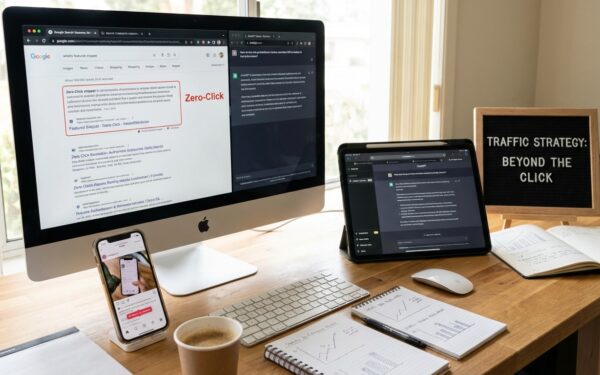
That said, ignoring what’s actually shifting would be malpractice. AI Overviews now appear on nearly 47% of Google searches — jumping to 88.1% for informational queries — and they’re cutting organic clicks by 58%, according to Ahrefs’ February 2026 data. Zero-click queries account for 60% of all searches overall. This isn’t a blip. It’s a structural change to how search delivers value.
So let me do what I’ve always done: cut through the noise and tell you what actually matters.
The Fundamentals That Aren’t Going Anywhere
EEAT Is Still the Core Signal — It’s Just Bigger Now
Google’s June 2025 Core Update doubled down hard on EEAT — Experience, Expertise, Authoritativeness, and Trustworthiness. This isn’t new language. Google has been talking about it for years. But the way it’s being applied in an AI-driven search environment has evolved a lot.
Think of EEAT as the modern version of what backlinks used to do on their own. It’s social proof at scale. A site with strong branded search volume, real author credentials, and genuine topical depth signals to both Google. And AI engines that it’s worth surfacing — whether in a traditional result or an AI Overview citation.
I’ve been preaching this to clients for years: build the brand, and the rankings follow. Ahrefs data shows that 45% of Google searches involve branded terms. That’s not a coincidence. Entities — brands, people, organizations — are increasingly how search engines organize and trust information. Your site isn’t just a collection of pages anymore. It’s a named entity in a knowledge graph.
“Google’s systems are designed to surface reliable information from trustworthy sources. Demonstrating that you are the authoritative source on a topic — not just for one page, but across your entire site — is what moves the needle.”
— John Mueller, Search Advocate, Google
If you want to go deeper on how Google evaluates author trust signals, I covered some of this in my post on Advanced Schema Markup: Going Beyond the Basics to Win Rich Results.
Technical SEO as the Entry Fee, Not the Trophy
Here’s something that might surprise you coming from a guy who’s spent years doing technical audits: technical SEO is now table stakes, not a differentiator. Only 40% of websites right now pass Core Web Vitals thresholds — LCP under 2.5 seconds, INP under 200 milliseconds, CLS under 0.1. If you’re in that 40%, you’re eligible. You’re not winning.
Google runs 500 to 600 algorithm updates per year. Most of them you’ll never notice if your technical foundation is solid. Crawlability, proper indexing, clean URL structures, mobile responsiveness — these are the things that keep you in the game. They don’t launch you to page one on their own.
My practical advice: get your Core Web Vitals into the green zone and then stop tweaking. I see too many site owners obsessing over shaving milliseconds off their LCP when their content strategy is a mess. Fix the foundation, then invest your energy where it actually moves the needle.
If you need a starting point, run through my guide on How to Audit Your Own Website Content in One Afternoon — it’ll help you prioritize what actually needs attention.
Content Clusters and Topical Authority
The pillar page and content cluster model has been around for a while, and it’s not going anywhere. In fact, it’s becoming more important as AI engines look for sites that show full coverage of a topic, not just one strong page.
When I build out a content strategy for a client, I’m thinking about how a human expert would organize a body of knowledge — broad overview at the top, specific subtopics branching out below, all connected through intentional internal linking. That structure is exactly what Google’s systems and AI citation engines are looking for when they decide who to quote in an AI Overview or Perplexity answer.
Topical authority isn’t about volume. I’ve seen sites with 20 tightly focused, deeply researched articles outrank sites with 500 thin pages. Quality and coherence win. Always have.
What’s Actually Changing (And Why It Matters)
GEO: Optimizing for AI Discovery, Not Just Google’s Blue Links
This is the one area where I’ll tell you something genuinely new is happening. Generative Engine Optimization (GEO) is the practice of structuring your content so that AI systems — Google’s AI Overviews, ChatGPT, Perplexity, Claude — can extract, cite, and surface it in their responses.
Here’s the stat that stopped me cold when I first saw it: AI-referred traffic converts at 4.4 times the rate of traditional organic search — 14.2% versus 2.8%, according to data from Averi.ai’s 2026 analysis of startup traffic sources. That’s not a rounding error. That’s a fundamentally different quality of visitor.
Why does AI traffic convert so well? Because by the time someone clicks through from an AI answer, they’ve already been pre-qualified. The AI gave them context, the site was cited as authoritative, and the user arrives with high intent and trust already established.
“The sites that will win in AI search aren’t the ones gaming prompts — they’re the ones that have spent years building genuine expertise. And making it easy for machines to understand and cite their content.”
— Lily Ray, VP of SEO Strategy & Research, Amsive
Practically speaking, GEO means writing direct answers near the top of your content, using FAQ sections with clear question-and-answer formatting, adding structured data (schema markup), citing real statistics with sources, and using clear headers that signal what each section covers. Sound familiar? It should — it’s just good content writing with intentional structure.
I wrote about how Google’s own AI delivery is evolving in my post on Google AI Mode Canvas: What It Means for Marketers and Content Strategy — worth reading if you want to understand the delivery side of this shift.
Branded Search Is Now an SEO Strategy, Not Just a Marketing Vanity Metric
I used to have to convince clients that branded search volume mattered for SEO. I don’t have that fight anymore — the data is too clear. When people search for your brand name, it signals to Google that you’re a real entity with real demand. That signal lifts your non-branded rankings too.
This is why I now treat brand building as an SEO activity. PR placements, podcast appearances, YouTube content, social presence — all of it feeds branded search volume, which feeds entity authority, which feeds rankings. The marketing and SEO silos are collapsing, and honestly, it’s about time.
What You Can Stop Obsessing Over
High-Volume AI-Generated Content for Mid-Funnel Rankings
I watched a lot of sites try to scale content production with AI in 2024 and early 2025. Some saw short-term gains. Then the March 2026 Core Update hit, and those gains evaporated. Google has gotten a lot better at identifying content that lacks genuine experience and depth.
I’m not saying don’t use AI in your content process — I use it myself. But AI as a research assistant and first-draft tool is very different from publishing raw AI output at scale and expecting it to rank. Human experience, real examples, and genuine perspective are what separate content that sticks from content that gets filtered out.
Chasing Every Algorithm Update
Google runs hundreds of updates a year. If you’re adjusting your strategy every time someone posts about a ranking fluctuation on X, you’re going to exhaust yourself and make your site worse. The sites that hold rankings through algorithm turbulence are the ones that built on solid fundamentals and didn’t panic-pivot every three months.
My rule: if a core update hits and your rankings drop a lot, that’s a signal to audit your content quality. And EEAT signals — not to chase whatever the SEO community is speculating about that week.
The Angle Most SEO Content Misses: Patience Is Still a Competitive Advantage
Here’s something I don’t see talked about enough in the “SEO in 2026” conversation: consistency compounds. The sites that are winning in AI citations and featured snippets right now are mostly sites that have been publishing quality content on focused topics for years. They didn’t get there because they figured out some new trick. They got there because they showed up, consistently, for a long time.
In a world where everyone’s chasing the next algorithm hack or AI prompt trick, being the person who just keeps doing the fundamentals well is actually a differentiated strategy. I’ve built businesses on that principle for two decades. It still works.
Resources
- Ahrefs SEO Statistics — Regularly updated data on organic CTR, AI Overviews, and search behavior
- Google Search Central: Creating Helpful, Reliable, People-First Content — Google’s official guidance on content quality
- Moz Whiteboard Friday — Practical, expert-led SEO education updated regularly
- Search Engine Land — News and analysis covering Google algorithm updates and SEO trends
- Semrush Blog — Data-driven SEO research and strategy guides
Frequently Asked Questions
Will traditional SEO still matter in 2026 with AI Overviews taking over?
Yes — but its role has shifted. Traditional SEO (indexing, crawlability, keyword alignment, technical health) is now the entry requirement for AI eligibility. You need it to be considered for AI citations and traditional rankings alike. It’s the foundation, not the finish line.
What is GEO and how is it different from SEO?
Generative Engine Optimization (GEO) is the practice of structuring content so AI systems like Google’s AI Overviews, ChatGPT, and Perplexity can extract and cite it accurately. It builds on traditional SEO fundamentals but adds emphasis on direct answers, FAQ formatting, schema markup, and cited statistics — making content machine-readable as well as human-readable.
Should I stop creating content if AI Overviews are reducing organic clicks?
No. The goal shifts from driving clicks to earning citations — and AI-referred traffic converts at a lot higher rates than traditional organic traffic when it does click through. The strategy is to structure your content for dual discovery: traditional search rankings and AI citation eligibility.
How important is branded search for SEO in 2026?
More important than most people realize. Ahrefs data shows 45% of Google searches involve branded terms. Branded search volume is a trust signal that lifts your non-branded rankings and reinforces your site as a named entity in Google’s knowledge systems. Brand building is now a legitimate SEO strategy, not just a marketing exercise.
The bottom line is this: the SEO landscape in 2026 is noisier, more complex, and faster-moving than ever. But the sites that are winning aren’t the ones who found some clever shortcut. They’re the ones who built real expertise, earned real trust, kept their technical house in order, and structured their content for both humans and machines. That’s been the game for 20 years. It’s still the game now.
If you want to talk through what this means for your specific site or business, reach out and let’s have a real conversation. No sales pitch — just an honest assessment of where you stand and what would actually move the needle.