


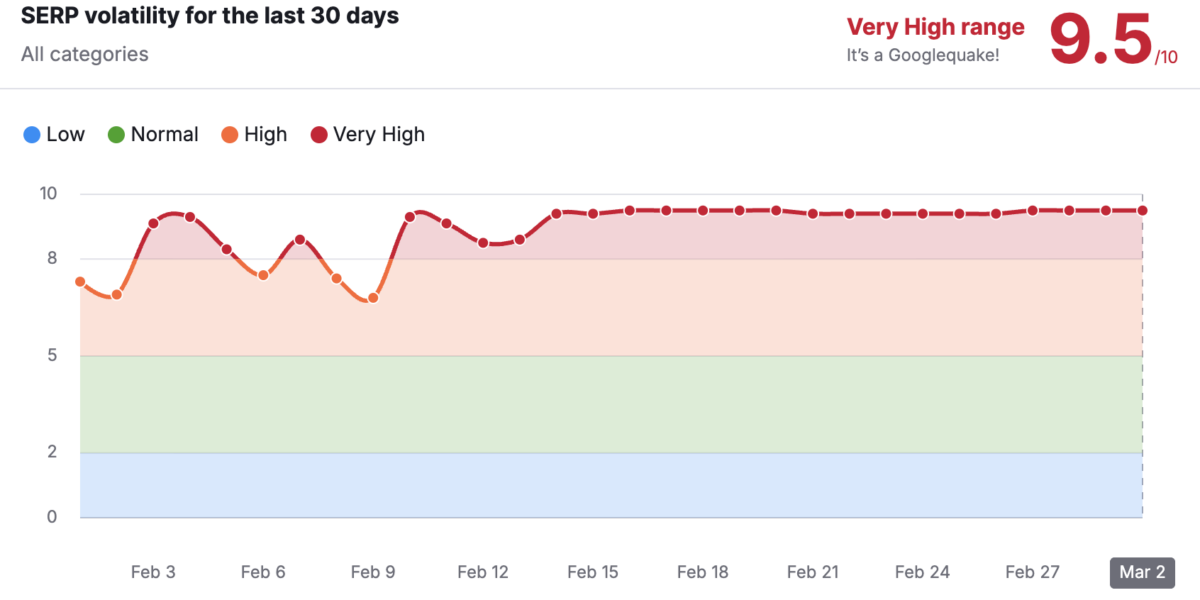
If you’ve noticed your Google rankings bouncing around more than usual lately, you’re not imagining it. Google search ranking volatility has stayed extremely elevated heading into March 2026, and the SEO community is feeling it hard.
Here’s what we know and what the tracking tools are showing.
What’s Happening With Google Rankings?
The short answer: a lot. Google has been pushing what appear to be near-daily updates — many of them smaller, unannounced core updates that Google itself hasn’t commented on publicly.
The February 2026 Google Discover Core Update started February 5, 2026 and officially wrapped up on February 27, 2026. But don’t let that “done” label fool you — volatility didn’t stop when the update ended.
SEOs thought things might be cooling off in the final week of February. Instead, the turbulence continued right into March. Desktop rankings are dropping for some sites while mobile rankings climb. Traffic swings of 20%+ in a single day are being reported across multiple niches.
A Look at the SERP Volatility Tools
The tracking tools are all lighting up. Here’s what they’re showing as of early March 2026:
SEMrush Sensor

Wincher SERP Volatility

Accuranker (Grump)

Mozcast

DataForSEO Volatility Index

Wireboard Aggregate View

What SEOs Are Actually Experiencing
Beyond the tracking tools, the SEO community is reporting real pain. Here’s what’s being said in forums like WebmasterWorld:
“Searches down 23% yesterday and 22% today so far. That is after the supposed end of the update. My top ranking terms dropped like a stone again yesterday and today for desktop searches. Mobile rankings are increasing.”
“Yes, it’s going at full strength, no slowdown at all.”
“SEMrush sensors are ranging to 9.5 now.”
The pattern some are seeing: desktop and mobile rankings diverging sharply, different page types (homepages vs. product pages vs. blog posts) taking turns ranking for the same keywords. Some are speculating a March core update may already be rolling quietly.
What This Means for Your SEO Strategy
A few practical takeaways if you’re navigating this volatility:
- Don’t panic-change your content. Rapid ranking swings during active updates often stabilize. Making major changes mid-flux can hurt more than help.
- Watch mobile vs. desktop separately. If your mobile rankings are climbing while desktop drops, that’s a signal about your mobile UX or mobile-first indexing signals — not necessarily your content quality.
- Monitor your key pages, not just overall traffic. Use position tracking for your money pages so you can see what’s actually moving vs. general noise.
- Document everything. Date your ranking changes alongside Google’s update timeline. When the dust settles, you’ll want to understand exactly what happened to which pages and why.
The Bigger Picture
We’ve now had sustained high volatility since at least early January 2026 — covering the Google December 2025 core update (Dec 11–29), unannounced smaller updates throughout January and February, and the February 2026 Discover Core Update (Feb 5–27). That’s nearly three months of near-constant algorithm activity.
Google hasn’t been transparent about these smaller, ongoing updates — which makes it harder to separate signal from noise when diagnosing ranking changes. The best tool you have right now is patience and clean data.
I’ll keep tracking this. If you’re seeing big swings in your own rankings, drop a comment — curious what niches are getting hit hardest.
Source: Search Engine Roundtable — Google Search Ranking Volatility Heated Into March