


If you run a local business and you’re not actively managing your Google Business Profile (GBP) — formerly called Google My Business — you’re leaving serious money on the table. I’ve been doing local SEO for over two decades, and I can tell you that nothing has changed the game for brick-and-mortar and service-area businesses quite like a fully optimized GBP. In 2026, with AI Overviews reshaping how people discover local services, getting this right is no longer optional. This Google My Business guide covers everything you need to know to dominate local search this year.
What Is Google Business Profile (And Why It Still Matters in 2026)
Google Business Profile is a free tool from Google that controls how your business appears in Google Search, Google Maps, and increasingly, in AI-generated answers. It’s the digital storefront that shows up before most searchers ever click through to your website.
According to Semrush’s comprehensive GBP guide, the platform lets you manage business information, collect reviews, post updates, and connect directly with customers — all at no cost. That’s an extraordinary amount of leverage for zero dollars.
Here’s what makes it so critical right now: 46% of all Google searches carry local intent. Nearly half of every search happening on Google is someone looking for something nearby. And when those searches happen, the Local Pack — that map section with three business listings — is the most visible real estate on the page.
I’ve worked with service businesses across Central Florida for years, and the pattern is consistent: the businesses showing up in that Local Pack are getting calls. The ones buried below it are not.
How Google Ranks Local Businesses: The Three Core Factors
Before you optimize anything, you need to understand what Google is actually looking at. The algorithm evaluates three primary factors for local rankings:
- Relevance: How well your profile matches what the searcher is looking for
- Distance: How close your business is to the person searching (or the location they specified)
- Prominence: How well-known and trusted your business appears across the web
You can’t move your physical location, but you absolutely can control relevance and prominence. That’s where optimization lives.
According to the Whitespark 2026 Local Search Ranking Factors survey, GBP signals now account for 32–35% of local pack rankings, making your profile the single most influential factor in whether you show up. Reviews come in second at 19–20%, followed by on-page signals at 14–15%.
That breakdown matters. It tells you exactly where to invest your time.
The Foundation: Setting Up and Verifying Your Profile Correctly
I’m always surprised how many businesses skip the basics. If you haven’t claimed your profile yet, go to business.google.com, search for your business name, and follow the verification steps. Most businesses can verify by phone, video, or postcard.
Business Name: Keep It Clean
Your business name in GBP should match your real-world branding — exactly. No keyword stuffing, no city names appended, no service descriptors tacked on. Google’s guidelines are explicit about this, and profiles that violate this rule get flagged or suspended.
I’ve seen businesses tank their rankings by trying to game the name field. It’s not worth it. Your name should be identical across your website, signage, invoices, and every directory listing you have online.
Categories: Choose With Precision
Your primary category is one of the most powerful signals in your entire profile. It tells Google what you fundamentally are. Choose the most specific category that matches your core revenue service — not a broad catch-all.
Secondary categories are fair game, but only add them if you genuinely offer those services. Category stuffing is a real problem that dilutes your relevance signal. I recommend checking what categories your top-ranking competitors are using in your market and benchmarking against them.
Service Area Businesses: Special Rules Apply
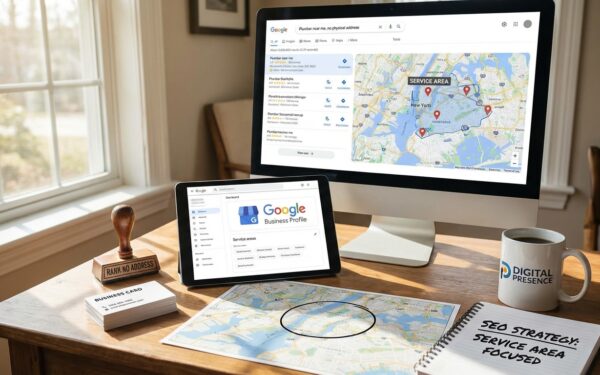
If you’re a plumber, landscaper, or any business that serves customers at their location rather than yours, you’re a Service Area Business (SAB). Per EZlocal’s 2026 GBP guide, SABs should hide their address if it’s a residential or non-public location, and define service areas realistically — generally up to about a two-hour drive radius. Don’t set your service area to cover half the state. Google knows.
Complete Your Profile: Every Field Counts
Complete profiles receive significantly more clicks than incomplete ones. This isn’t a minor difference — it’s the gap between being found and being invisible.
Business Description
Write your description in plain, natural language. State clearly what you do and where you serve. Mention your key services once — not three times. Skip the emojis and the promotional fluff. Google’s AI is parsing this for entity and intent signals, not marketing copy.
Keep it under 750 characters and update it at least once a year. Freshness matters more than it used to.
Services Section: Don’t Leave This Empty
The Services section is where most businesses lose ground, and it’s one of the easiest wins available. Add every service you offer with a real description written for humans, not bots. According to research compiled by LocalMighty’s 2026 optimization checklist, services are now heavily weighted in how Google matches profiles to specific search queries.
Adding detailed services has been shown to increase discovery searches meaningfully. I’ve seen this play out firsthand with clients — filling out the services section with specific, descriptive entries consistently moves the needle on impressions within a few weeks.
Hours, Phone, and Website
These seem obvious, but keep them current. Update holiday hours proactively. An incorrect phone number or outdated hours isn’t just an inconvenience — it’s a trust signal failure that affects both users and Google’s confidence in your profile.
Photos and Video: The Engagement Multiplier
Photos aren’t decoration. They’re an engagement signal that directly influences how often your profile gets clicked and how prominently it appears.
In 2026, Google’s algorithms favor immersive content — 360-degree photos, short-form videos, and regular photo updates over static galleries that haven’t changed in two years. I tell my clients to treat their GBP photo section like a living portfolio, not a one-time upload.
Here’s what to include at minimum:
- A high-quality cover photo that represents your brand clearly
- Interior and exterior shots of your location (if applicable)
- Team photos showing real people doing real work
- Product or service photos with good lighting
- Short video clips (30–60 seconds) showing your work or space
Don’t just upload stock photos. Google can identify them, and real customers definitely can. Authentic imagery builds trust in a way that stock never will.
Reviews: Your Most Powerful Trust Signal
Reviews are the second-largest ranking factor in local search, and they’re the primary thing a potential customer reads before deciding to call you. According to BrightLocal’s consumer research, 87% of consumers read online reviews for local businesses. That number has stayed consistently high for years, and it’s not going down.
“Businesses that actively respond to reviews are seen as 1.7 times more trustworthy than businesses that don’t respond at all.”
— BrightLocal, Local Consumer Review Survey
Here’s my approach to reviews, refined over years of working with local clients:
Ask for Reviews Systematically, Not Randomly
The businesses with the most reviews aren’t lucky — they have a process. Ask every satisfied customer at the right moment (right after a successful job or transaction) and make it easy by sending a direct link to your review page.
Never buy reviews. Never script them. Never incentivize them with discounts or gifts. Google’s detection has gotten significantly better, and the penalty isn’t worth any short-term gain.
Respond to Every Review
Every single one — positive and negative. Your responses aren’t just for the reviewer. They’re for every future customer reading that thread. Keep responses genuine, add natural service context where appropriate, and never stuff keywords into replies.
Review Velocity Matters More Than Volume
A steady stream of recent reviews outperforms a large volume of old ones. Google weights recency heavily. Focus on the last 90 days, not your lifetime total. Consistent monthly review acquisition beats a one-time push every time.
NAP Consistency: The Silent Ranking Killer
NAP stands for Name, Address, Phone number — the three core data points that define your business identity across the web. Inconsistency here causes real problems in 2026.
AI indexing has made Google more sensitive to NAP mismatches than ever before. One outdated listing on Yelp, an old address on a chamber of commerce directory, a phone number variation on an industry site — these create conflicting signals that erode Google’s confidence in your profile.
Audit your citations at least twice a year. Tools like Moz Local or Semrush’s listing management feature can help you find and fix inconsistencies at scale. This is one of those unsexy tasks that pays consistent dividends.
This ties directly into what I covered in my Local SEO for Small Businesses guide — citation consistency is foundational, not optional.
Google Posts: Stay Active, Stay Relevant
Google Posts are short updates that appear directly on your GBP listing. They’re one of the clearest engagement signals you can send to Google’s algorithm — and most businesses completely ignore them.
Post at minimum once a week. Use posts for:
- Current promotions or offers
- New services or products
- Upcoming events
- Recent project highlights or case studies
- Answers to common customer questions
Posts expire after seven days (except event posts), so consistency matters. An active profile signals to Google that your business is current and engaged — which aligns with the freshness signals that have gained weight in post-2025 algorithm updates.
Q&A Section: Control the Narrative
The Questions & Answers section on your GBP is publicly editable — meaning anyone can ask a question and anyone can answer it. If you’re not monitoring and seeding this section yourself, you’re leaving your brand narrative to chance.
Proactively add the questions your customers actually ask most often, then answer them thoroughly. This serves double duty: it helps real customers and it feeds structured information to Google’s AI for potential inclusion in AI Overviews and answer boxes.
With Gemini AI increasingly pulling from GBP data to generate conversational answers, a well-populated Q&A section is becoming a meaningful visibility lever. Make sure your answers align with the content on your website — consistency across touchpoints matters for entity recognition.
Booking and Messaging: The Conversion Layer
If your business type supports it, enabling booking integrations and the messaging feature can meaningfully increase conversions. Profiles with booking or messaging options active have shown notably higher conversion rates compared to profiles without them.
The logic is simple: every additional friction point between a customer’s intent and their action costs you conversions. If someone can book an appointment directly from your GBP listing without visiting your website, a meaningful percentage of them will. Make it easy.
For service businesses especially, this pairs well with the broader conversion strategies I outlined in my Conversion Rate Optimization for Service Business Websites guide.
GBP in the Age of AI Overviews
This is the angle most guides are still missing, and it’s the most important shift happening right now.
Google’s AI Overviews and Gemini-powered search results are changing how people discover local businesses. Instead of typing “plumber Orlando,” users are asking “Who’s the best-rated plumber in Orlando who can come out same day?” These conversational queries require your profile to have structured, complete, entity-rich information to be surfaced in AI-generated answers.
“The businesses that will win in AI-driven local search are the ones that have built genuine authority signals — complete profiles, consistent citations, real reviews, and content that actually answers the questions people are asking.”
— Darren Shaw, Founder, Whitespark
What this means practically:
- Your GBP description, services, and Q&A should use natural language that mirrors how people ask questions
- Your website content should align with and expand on what’s in your GBP
- E-E-A-T signals — real reviews, real credentials, real experience — matter more than ever
- Structured data on your website reinforces what your GBP communicates to Google’s AI
I’ve written about this broader shift in my post on the Google Core Update 2026 and how AI content SEO changed rankings — the principles overlap significantly with local search.
Advanced GBP Optimization: What Separates Good From Great
Use UTM Parameters on Your Website Link
Add UTM parameters to the website URL in your GBP so you can track exactly how much traffic is coming from your profile in Google Analytics. This is basic but surprisingly rare. You can’t improve what you don’t measure.
Monitor Your Insights Regularly
GBP Insights shows you how customers find your profile (direct searches vs. discovery searches), what actions they take (calls, direction requests, website clicks), and how your photos perform compared to competitors. Review this data monthly and let it guide your optimization priorities.
Audit Competitor Profiles
Search your primary service keywords in your market and study the top three profiles in the Local Pack. What categories are they using? How many reviews do they have? How recently did they post? How detailed are their service descriptions? This competitive intelligence is free and invaluable.
Keep Your Profile Aligned With Your Website
Google cross-references your GBP with your website. Inconsistencies between the two — different services listed, different service areas described, different business descriptions — create entity confusion. Your website and GBP should tell a consistent story. This is especially important as Gemini AI increasingly pulls from linked websites to auto-generate answers within your profile.
Common GBP Mistakes That Kill Local Rankings
- Keyword stuffing the business name — violates Google’s guidelines and risks suspension
- Using a virtual office address — Google’s verification processes have tightened significantly
- Ignoring negative reviews — silence reads as indifference to both Google and future customers
- Setting unrealistic service areas — claiming you serve a 200-mile radius when you’re a one-person operation signals spam
- Uploading photos once and never updating them — stale profiles lose engagement signals over time
- Letting NAP inconsistencies accumulate — one outdated directory listing can undermine an otherwise strong profile
For a broader look at technical and on-page factors that support your local SEO, my SEO Checklist 2026 covers the full picture.
FAQ: Google Business Profile Optimization
How long does it take to see results from GBP optimization?
In my experience, most businesses see measurable improvements in impressions and clicks within 4–8 weeks of completing a full optimization. More competitive markets may take 3–6 months to see significant Local Pack movement. Consistency matters more than any single change.
Does having more Google reviews guarantee a higher ranking?
Not by itself. Reviews are one signal among many, and review quality, recency, and response rate all factor in. A business with 50 recent, detailed reviews will often outrank one with 300 old, thin reviews. Focus on steady acquisition over time, not volume alone.
Can I have a GBP if I work from home and don’t want to show my address?
Yes. If you’re a service-area business that serves customers at their location, you can hide your address in GBP. You’ll need to verify your location during setup, but your address won’t be publicly displayed. Define your service areas accurately instead.
How often should I update my Google Business Profile?
At a minimum: post weekly updates via Google Posts, respond to reviews within 48 hours, and audit your core profile information (categories, services, hours, description) quarterly. Photos should be refreshed at least monthly. The more active your profile, the stronger your freshness signals.
Resources
- Google – Official Guidelines for Representing Your Business on Google
- Semrush – The Ultimate Guide to Google Business Profile
- Moz – Local SEO Learning Center
- Whitespark – 2026 Local Search Ranking Factors Survey
- LocalMighty – Google Business Profile Optimization Checklist for 2026
The Bottom Line
Google Business Profile optimization in 2026 is not a set-it-and-forget-it task. It’s an ongoing practice that rewards consistency, authenticity, and attention to detail. The businesses winning in local search right now are the ones treating their GBP as a living asset — not a static listing.
Start with the foundation: verify your profile, nail your categories, complete every field. Then build the trust signals: earn reviews systematically, respond to every one, keep your NAP consistent everywhere. Then stay active: post weekly, update photos, answer questions, monitor your insights.
Do those three things consistently and you’ll outperform most of your local competitors — because most of them aren’t doing all three at once.
If you want help auditing your current GBP setup or building a local SEO strategy that goes beyond the profile itself, reach out and let’s talk. I’ve been doing this long enough to know what actually moves the needle — and what’s just noise.
TL;DR
- Definition: Google Business Profile (GBP), formerly Google My Business, is a free tool that controls how a business appears in Google Search, Google Maps, and AI-generated local answers.
- Top ranking factor: GBP signals account for 32–35% of local pack rankings according to the Whitespark 2026 Local Search Ranking Factors survey, making it the single most influential local SEO factor.
- Local search scale: 46% of all Google searches have local intent, meaning nearly half of all searches are looking for something nearby.
- Reviews matter: Reviews are the second-largest local ranking factor at 19–20%, and 87% of consumers read online reviews for local businesses before making a decision.
- AI impact: Google’s AI Overviews and Gemini AI now surface local businesses based on structured, entity-rich profile data — making complete, consistent, and detailed profiles essential for AI visibility.
- NAP consistency: Name, Address, and Phone number must be identical across all online directories; even a single inconsistency can negatively affect local pack rankings due to AI indexing sensitivity.
- Key optimization actions: Complete all profile fields, choose precise categories, add detailed service descriptions, upload fresh photos regularly, post weekly updates, and respond to every review.
- Service area businesses: SABs should hide residential addresses, define realistic service areas (generally up to a two-hour drive radius), and verify ownership through video or documentation as required by Google’s 2025–2026 guidelines.